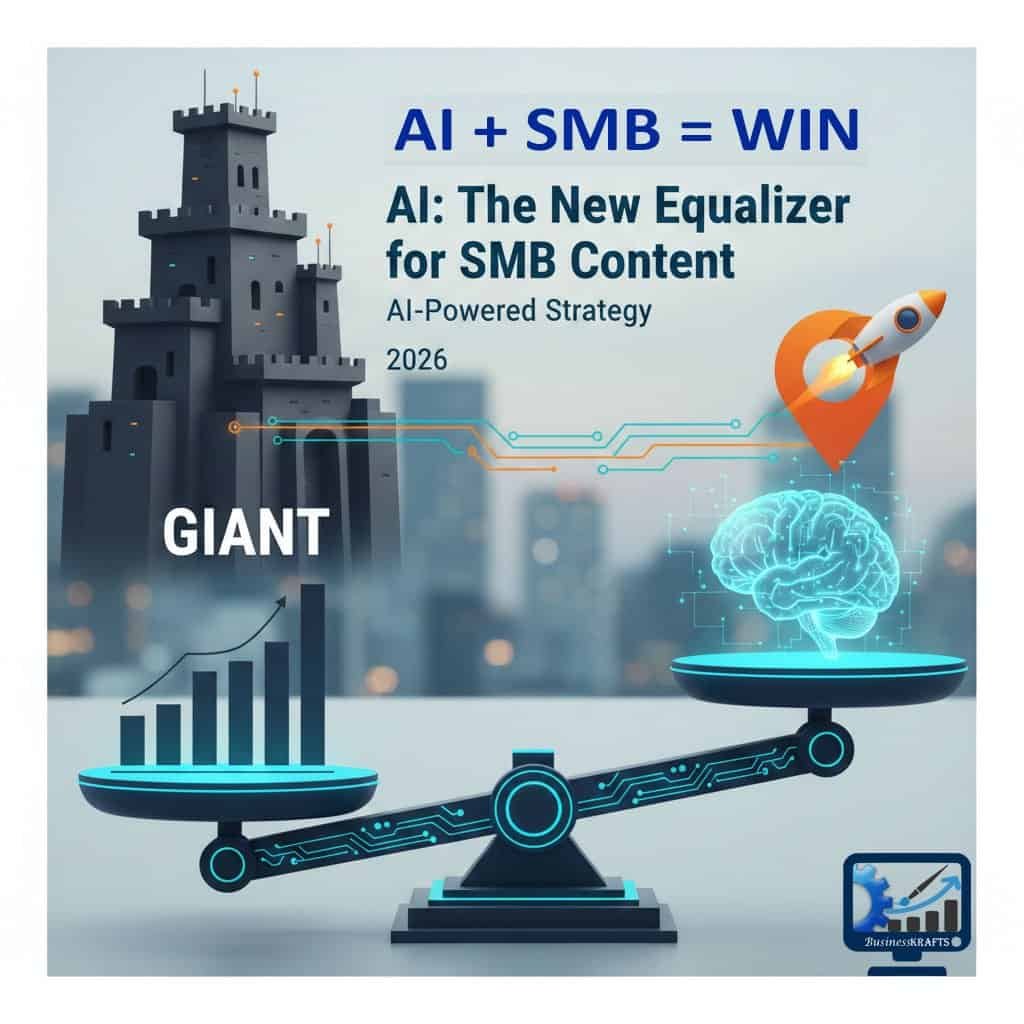
When Rohan, a small leather-goods manufacturer in Ahmedabad, tried to compete with a national retail chain, he did what most founders do — he worked harder. He posted more, emailed more, designed more ads, and even learned basic video editing. But after six exhausting months, he realized something heartbreaking:
“They are everywhere. I cannot compete with this.” He wasn’t just losing sales — he was losing belief that he could ever be visible.
That is the emotional truth many entrepreneurs quietly face in 2026. The digital marketplace has become louder. Consumers move faster. Search engines think differently. And large companies seem to have infinite fuel.
But here’s the part that is rarely spoken out loud:
For the first time in history, small businesses genuinely have a strategic advantage, IF they master AI-powered content systems.
Not shortcuts. Not templates. But the Systems.
This article — part of the BusinessKrafts Content Marketing Series — is your field manual. The 10,000-word Master Guide is the textbook. This is the version you keep open on your second screen as you execute.
In 2026, small businesses are no longer competing only on price or product quality. They’re competing on clarity, trust, and the ability to demonstrate expertise more quickly than larger competitors can approve a campaign. AI has removed the “resource gap,” leaving only the “strategy gap.” This is why understanding content systems has become a survival skill, not a marketing accessory.
Who this guide is for:
This playbook is for founders, solo entrepreneurs, consultants, and small teams who want predictable growth without running a full marketing department.
Why now:
2026 is the first year where content performance depends more on structure, trust signals, and entity clarity than on ad budgets or team size. That shift creates unprecedented opportunity for SMBs.
Let’s begin.
1. Content Marketing in 2026: What Changed — and What Didn’t
If 2020–2023 was the “digital acceleration era,” then 2024–2026 is the “meaning acceleration era.”
- Search engines changed.
- Customers changed.
- Platforms changed.
- Founders changed.
But one thing didn’t:
People still trust clarity, honesty, and expertise more than anything else.
Rohan’s turning point
After months of trying everything, he stumbled onto a pattern:
- His long posts didn’t work.
- His expensive ads didn’t convert.
- His “fancy” reels didn’t reach anyone meaningful.
But a simple blog post he wrote at midnight — “How to Maintain Leather Bags During Indian Monsoons” — suddenly started ranking and bringing traffic.
Why?
Because for the first time, he wrote with meaning, not marketing.
This is how growth happens in 2026.
The 5 Big Shifts of 2026 (Quick Summary)
- Search engines read meaning, not keywords.
- Audiences trust lived experience more than polished branding.
- Visual logic (diagrams, checklists, summaries) replaces long paragraphs.
- AI removes research friction, making strategy the differentiator.
- Mobile behavior dictates structure, clarity, and pacing.
Together, these shifts redefine content from “what you publish” to “how clearly and consistently you demonstrate expertise.” These shifts changed how people consume, not just how algorithms rank. People want answers that feel real, fast, and usable — not corporate polish.
1.1 How AI Changed Content (2024 → 2026)
AI didn’t destroy content — it rewired the hierarchy of trust.
AI didn’t steal creativity; it removed the repetitive parts of content creation. Founders who once struggled with research, structuring, and rewriting can now spend more time on storytelling, examples, and lived experience — the things AI cannot replicate. This shift has made founder-led content more valuable, not less.
AI also forced creators to double-down on accuracy — vague claims and unverified tips now collapse rankings quickly.
AI also changed how we understand competitors.
Modern AI tools can analyze hundreds of competitor pages, extract structural patterns, identify missing content gaps, and reveal intent clusters within minutes — something impossible for SMBs earlier.
And AI raised the bar for trust.
Search engines now prioritize content that demonstrates verifiable expertise, transparent authorship, precise claims, and human editing. AI-generated fluff is instantly filtered out.
Search moved from keywords → entities
Google no longer rewards the website that says the most.
It rewards the website that knows the most — and proves it through structure.
Search engines now evaluate:
- Who you (and your brand) are
- What topics you repeatedly own
- Whether your content connects
- Whether your advice is grounded in experience
For Rohan, this meant that posting random tips weekly did nothing. But when he grouped his content into clusters — Leather Care, Buying Guides, Craftsmanship Stories — Google finally “understood” his expertise.
Answers now outperform ads
People no longer trust performance ads blindly. They scroll past them, waiting for someone who speaks directly and honestly.
The content that wins now has:
- Clear hierarchy
- A problem-solving tone
- Visual logic (diagrams, examples)
- A human voice
Mobile-first content behavior
In 2026, over 80% of SMB-related searches begin on mobile. This means your content must:
- load fast
- display cleanly
- avoid dense blocks of text
- use subheadings every 2–3 paragraphs
- include one-sentence summaries
- Break paragraphs every 2–3 lines — modern readers scroll, they don’t read.
Mobile reading changed the definition of ‘good content’ more than any algorithm did.
The Skim Test
You have 3 seconds.
Skim → Trust → Engage → Convert
If a post fails at “Skim,” everything else collapses.
This is why your:
- H2s
- Subheadings
- Checklists
- Single-sentence summaries
- Diagrams
matter more than ever before.
AI Overview now dominates discoverability
Google’s AI Overview (AIO) surface pulls content that:
- Has strong entity relationships
- Has hierarchical clarity
- Demonstrates experience
- Connects to supportive visuals
- Solves a real problem
In Rohan’s case, his blog post worked because it wasn’t fluffy — it answered a real seasonal problem.
That single piece unlocked his belief that he could compete — not by shouting, but by structuring.
1.2 The SMB Reality: Why Content Is Still Hard
Small businesses still struggle — not from lack of ability, but from overload. The emotional toll is real: guilt from inconsistency, fear of wasted money, embarrassment from low engagement, and constant comparison with bigger brands.
The three real reasons SMBs struggle with content:
- No system: Content is created reactively, not strategically.
- No signals: Search engines cannot see expertise because content is unstructured.
- No consistency: Even high-quality posts fail when published irregularly.
Mindset Shift for 2026:
You don’t need daily posting. You need weekly signals that build authority, clarity, and entity strength. Consistency is not about volume, it’s about showing up predictably with clarity.
Budget tension (“Treatonomics”)
Most founders do not want “marketing.”
They want:
- Predictable outcomes
- Low-risk systems
- Clear tasks
- Tools that don’t require a 5-member team
AI is attractive because it reduces chaos, not because it’s trendy.
Operational fatigue
SMBs face a reality giants don’t:
- One founder doing 7 roles
- Posting inconsistently
- No interlinking
- No keyword discipline
- No content hygiene
- No time to research
- No time to measure
The authority gap
Big brands do not need to prove who they are.
SMBs must earn authority — repeatedly.
But here’s the empowering part:
Authority today is earned through clarity, not size.
When Rohan wrote from real experience and organized his content, he finally “felt seen” by the algorithm — and by customers.
2. Core Strategy: How SMBs Can Beat Giants
Let’s be blunt:
You cannot beat large companies in scale. But you can beat them in relevance, speed, clarity, and emotion.
Content marketing in 2026 isn’t about being everywhere. It’s about being undeniably useful where it matters. Most SMBs fail because they spread themselves too thin; the winners focus on one pillar and 5–8 clusters.
Why founder-led content wins in 2026:
Audiences and algorithms both reward content that carries lived experience, original viewpoints, and contextual relevance. A founder’s real stories outperform a 10-member content team producing generic material.
The Strategic Triangle for SMBs:
- Meaning: Your expertise and unique stories
- Mechanics: Structure, clarity, and interlinking
- Momentum: Consistency powered by AI
Master these three, and you outperform brands with 20× your budget.
2.1 Why Giants Win Today and Why SMBs Can Win Tomorrow
1. Giants win with volume — SMBs win with depth.
Depth is not simply longer content. It means:
- solving a clearly-defined pain
- using examples from real customers
- reflecting cultural & local nuances
- providing steps people can follow immediately
Depth builds trust because it reflects effort.
Volume builds awareness, but depth builds authority.
Corporations publish hundreds of articles because they have teams. But their content often lacks:
- Soul
- Precision
- Local nuance
- Founder’s experience
SMBs can outperform them with:
- 25–30 high-value articles
- Clear clusters
- Interlinked systems
- Founder voice
2. Giants rely on brand authority — SMBs build earned authority.
SMBs win when they combine:
- Founder-led examples
- Relatable stories
- Checklists and frameworks
- Clear schema and entity signals
3. Giants analyze data — SMBs interpret meaning.
A corporate content team may know that:
“Page X has a low engagement rate.”
But an SMB founder like Rohan knows:
“Customers aren’t resonating because the advice isn’t practical for Indian monsoons.”
Meaning > Metrics
Speed > Hierarchy
Relevance > Budget
Giants vs SMBs — The 2026 Comparison
| Factor | Giants | SMBs | Winner |
|---|---|---|---|
| Speed of execution | Slow (approvals) | Fast (founder decisions) | SMBs |
| Content quantity | High | Moderate | Giants |
| Content depth & originality | Low–medium | High | SMBs |
| Cultural relevance | Low | High | SMBs |
| Ability to pivot | Slow | Instant | SMBs |
In 2026, small teams win not by competing on volume, but by competing on precision.
Speed + depth beats volume in 2026.
2.2 David vs Goliath Content Positioning
SMBs connect best with frameworks that simplify emotions into decisions.
PAS (Problem → Agitate → Solution)
Example: A boutique accounting firm wrote a post titled – “Why Most Small Businesses Overpay Their Taxes”. The ‘agitate’ section highlighted how founders unknowingly skip deductions, and the ‘solution’ section positioned a simple 20-minute AI-assisted checklist. This post alone brought them 11 consultations in two weeks.
This works because founders want to understand their pain clearly before acting.
Example from a business coaching startup:
Problem: “Your content isn’t converting.”
Agitate: “Because you’re trying to grow without strategy.”
Solution: “Here’s a 30-day cluster plan driven by AI + founder insights.”
BAB (Before → After → Bridge)
This works for transformation narratives.
A bakery owner in Jaipur explained her journey: This simple transformation story resonated because it mirrored what thousands of founders feel: inconsistency isn’t a lack of discipline — it’s a lack of system. The BAB framework turns chaos into clarity by showing the “before pain,” “after possibility,” and the bridge that connects them.
- Before: Posting reels randomly
- After: Consistent leads via a structured weekly calendar
- Bridge: A hybrid AI workflow with automated prompts
Implementation-first storytelling
Don’t motivate.
Don’t hype.
Show steps.
Founders connect when you say things like:
- “Here are your next 5 tasks.”
- “This is your 4-step weekly cycle.”
- “Here is the checklist I personally use.”
The “Context → Insight → Action” Formula (CIA)
Perfect for expert-driven content.
CIA also aligns perfectly with AI Overview extraction because it presents meaning in a clean, layered sequence.
- Context: Describe the situation
- Insight: Reveal what most people miss
- Action: Show what to do next
Example:
Context: “Most bakery owners think sales dip because of competition.”
Insight: “But data shows 48% of customers drop off due to unclear product categories.”
Action: “Here’s a 3-step restructuring template to fix your menu.”
3. The AI-Powered Content Engine (Hybrid & Human)
AI in 2026 is not a replacement for expertise.
It is a replacement for:
- Overwhelm
- Repetition
- Inconsistency
- Manual research
- Structural planning
The human remains the narrator. AI becomes the context builder.
What NOT to automate
Even in 2026, certain parts of content should remain 100% human:
- Customer stories
- Founder experiences
- Cultural context
- Ethical statements
- Sensitive topics
- Final approval
These elements carry emotional weight — something AI cannot authentically produce.
Let’s break down the engine.
3.1 The Three Layers SMBs Actually Need
3.2 Research + Planning Agents (The Thinking Layer)
These tools help you:
- Generate entity maps
- Build topical clusters
- Identify trends
- Extract patterns from competitors
- Understand buyer fears and motivations
This is where founders get 10x clarity.
An example:
Jia, who runs a home-baking business, used AI to discover that “eggless cakes for diabetics” was an unexplored cluster in her city. That insight alone transformed her revenue.
Another example: A physiotherapist in Hyderabad used AI to analyze recurring patterns in patient queries and discovered that “knee pain after 40” had hundreds of unanswered micro-questions. This single insight helped her create a 10-post cluster that now drives 70% of her website’s traffic.
3.3 Writing + Editing + Compliance Tools (The Shaping Layer)
AI can:
- Draft without fluff
- Improve clarity
- Fix tone inconsistencies
- Flag risky claims
- Suggest structure
- Prepare snippet-ready headings
- Improve readability
But the human must refine the soul and experience.
3.4 Distribution + Automation + Analytics Tools (The Momentum Layer)
These tools:
- Automatically distribute content
- Maintain CRM hygiene
- Summarize performance
- Detect decay
- Suggest updates
This reduces founder workload significantly. There are multiple Low-Cost AI Automation Stacks for Content Marketing.
3. Human + AI Workflow: Roles That Actually Work
| Task | Human | AI |
| Topic selection | ✔ | |
| Research | ✔ | ✔ |
| First draft | ✔ | |
| Editing for clarity | ✔ | ✔ |
| Compliance | ✔ | |
| Tone, voice, narrative | ✔ | |
| Scheduling & CRM | ✔ | |
| Interpretation | ✔ |
Guardrails
- No publishing without human review
- No fake reviews or synthetic claims
- Maintain a stable founder voice
- Treat AI as a system, not a savior
Your expertise remains the differentiator; AI only makes it easier to express it consistently.
A practical productivity tip:
Founders who succeed with hybrid workflows usually follow a simple rule: Spend your best 20 minutes on thinking, and let AI execute the next 2 hours.
The Trust Formula
Accuracy → Trust → Velocity → Visibility → Growth
4. The 90-Day Roadmap (Founder-Friendly)
This is the most practical, SMB-ready roadmap you will find.
Why 90 days?
Because search engines need time to understand your entity, clusters need time to interlink, and your audience needs time to notice your consistency. 90 days is long enough to build momentum and short enough to stay energetic.
Most SMBs fail not due to poor content, but due to quitting too early before the system compounds.
No vague advice. No unrealistic expectations. Just actionable clarity.
4.1 Week 1: Idea Validation
The goal is to avoid wasting 90 days on bad topics.
Ask:
- Does this solve a real pain?
- Can readers understand the idea in one skim?
- Is it commercially useful?
- Can I interlink it later?
- Can it support visuals, snippets, FAQs?
- Does it match my expertise?
Deliverables
- 12–18 clusters
- Entity map
- PAA questions
- Outline
- One diagram idea
4.2 Month 1: Build Cluster Content
Create 6–8 cluster posts (1,200–1,500 words each). Each cluster post should include:
- ✔ One core problem
- ✔ One actionable framework
- ✔ One diagram or example
- ✔ 3–5 interlinks
- ✔ 1 short CTA
- ✔ A human anecdote or insight
This ensures every cluster strengthens your overall authority.
Interlinking Rule
- Service pages → Pillar
- Pillar → Service pages
- Clusters → Pillar → Master Guide
This forms your SEO city — not random buildings.
Example: A boutique gym in Pune
Their clusters were:
- Weight loss myths
- Female fitness misconceptions
- Home workout plans
- Diet mistakes
- Beginner routines
This strategy doubled their organic leads in 60 days.
4.3 Month 2: Social + Search Velocity Push
Create 3 main visuals:
- SMB vs Giant comparison
- AI content funnel
- 90-day trend line
Push distribution across:
- Facebook stories
- WhatsApp founder groups
- GMB posts
- Niche communities
Posting Rhythm
- 3 LinkedIn posts/week
- 2 Meta stories/week
- 1 founder-group post every 10 days
- Refresh recaps on Days 45 & 75
Common distribution mistakes to avoid:
- ✘ Posting the same content everywhere
- ✘ Over-explaining instead of giving 3–5 insights
- ✘ Adding heavy graphics instead of clean visuals
- ✘ Ignoring comments and conversations
- ✘ Stopping after 3 quiet posts
Distribution is a discipline — not a lucky break.
4.4 Micro + Nano Community Distribution
The highest ROI distribution channel for SMBs?
Real founder communities.
Forget ads. Forget influencers.
Instead, share:
- Checklists
- Screenshots
- Behind-the-scenes
- Mini-lessons
- Small wins
Authenticity beats advertising.
5. Case Snapshots (Narrative-Driven)
Case 1: The Regional Training Startup
Struggles
- Robotic headlines
- No interlinking
- Irregular posting
- Poor structure
- Zero entity signals
AI-powered intervention
- Built cluster map
- AI drafts → human refinement
- Added diagrams
- Interlinked with 18+ anchors
- Founder rewrote intros with PAS
Results
- Top-20 visibility in 30 days
- Four posts in Top-10 by Day 55
- 41% time-on-page increase
- Leads started Week 9
- 12K+ community clicks
They didn’t act like a giant.
They acted structured.
Case 2: Home Décor Brand in Kolkata
Anita, founder of a handmade décor shop, wrote 200+ Instagram captions in one year — but got almost no traction.
When she switched to a hybrid content system:
- Built 8 clusters
- Created 1 pillar
- Added diagrams
- Posted structured stories
- Automated distribution
- Fixed internal linking
Outcome
Within 60 days:
- Website traffic doubled
- Her “Diwali Lighting Guide” reached AIO
- She closed 17 new orders
- Her DMs became meaningful conversations, not random likes
Anita didn’t grow because she posted more.
She grew because she posted with meaning.
Case 3: Local Service Provider (Electrician in Chennai)
A solo electrician documented 20 real household problems he solved. Using AI, he converted each into a 700–1000-word article with images. In 45 days, his “Why Your MCB Trips at Night” post ranked locally. Calls increased by 63% — with zero ads. This is the power of structured storytelling.
What all successful SMB case studies have in common
- They didn’t increase posting frequency — they increased structure.
- They used AI for repetition, not representation.
- They turned real customer experiences into content.
- They improved internal linking every week.
- They used one core pillar to power multiple clusters.
These patterns are universal regardless of industry.
6. Final Insight: The Winning Pattern
A pattern emerges across all SMBs that succeed:
Trust → Velocity → Visibility → Viewers → Revenue
Your content will win if it:
- Builds trust in the skim
- Delivers clarity in layers
- Shows experience
- Has strong internal linking
- Ships consistently
- Refreshes before decay
You do not need to act bigger than giants.
You need to act smarter than their systems.
That is your advantage. That is your story.
Your only responsibility is to show up with clarity and honest intention. AI will handle the structure, but only you can provide the experience that makes your content believable. That combination — human meaning + AI discipline — is unbeatable in 2026. That is the 2026 content era.
Your next step
- Pick one cluster topic today.
- Draft the outline.
- Let AI shape it.
- Add your lived experience.
- Publish one meaningful post this week.
That single move starts the entire flywheel.
Very helpful and insightful article. Thanks for writing this.
Comments are closed.