For years, digital marketing strategy revolved around one simple expectation: Someone searches, they click, they land on your website, conversions happen. This model is no longer reliable as a primary growth assumption.
The Zero-Click Search era has arrived. Search engines, and now AI Overviews and Chatbots (like ChatGPT and Copilot), increasingly answer queries without sending users to websites. Many brands panicked:
- “We’re losing traffic.”
- “Clicks are down.”
- “Google is taking our content.”
- “AI is becoming a competitor.”
But this panic overlooks a deeper structural truth: Zero-Click Search is not a loss of traffic; it is the migration of trust, expertise, and brand perception into the search and AI answer layer itself. And that layer is becoming the new arena for thought-leadership visibility. In other words:
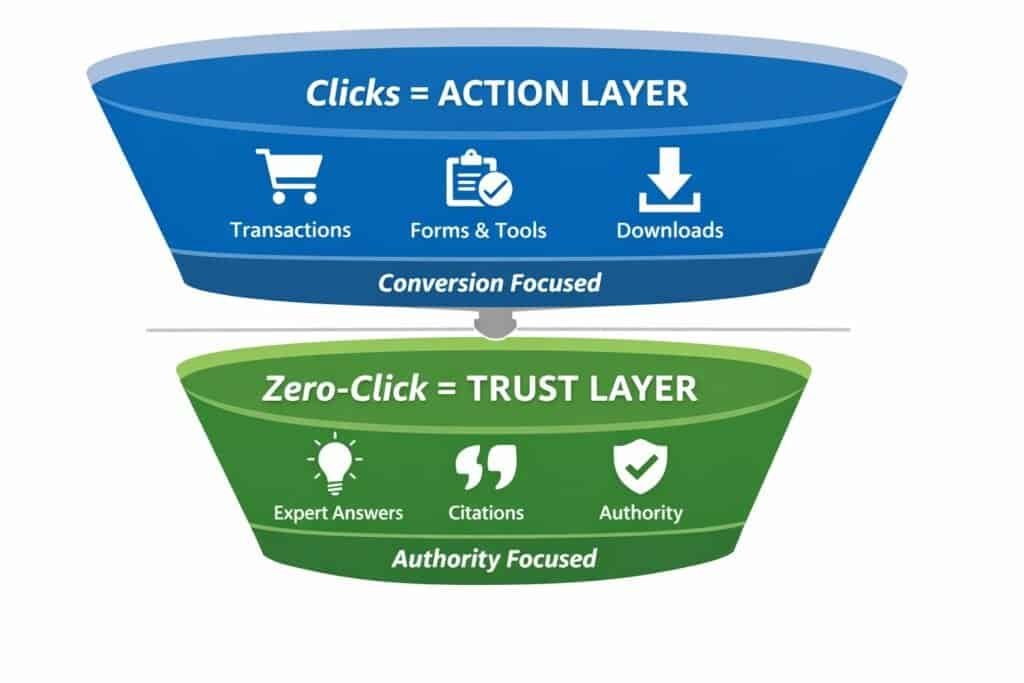
Clicks measure transactions, Zero-Click measures authority; authority compounds, traffic fluctuates.
Scope note (why this post exists)
This is not a long-term research paper. It is a strategy memo based on short-window observations (roughly 24 hours) from repeated searches and screenshots. The goal is to surface a useful strategic shift for the AI era, not to make permanent claims about rankings, AI Overviews, or citations.
We’re publishing this to break a short silence after our last meaningful post and to document what the interfaces appear to be rewarding right now, while it’s still fresh.
This perspective is not purely theoretical. It emerged sharply for us during short-window observations across AI-led search surfaces, and it matches patterns we’ve been tracking in practice.
In that observation window, we saw this shift play out across two kinds of assets: a long-form strategy guide and a structured glossary built for definitional clarity. Across repeated checks, both did surface in AI-led environments even when standard rankings moved. In the same window, several click-centric assets showed weaker visibility across surfaces.
Where Clicks Still Matter
Zero-Click doesn’t eliminate clicks; it changes what clicks represent. Clicks still matter most when the user needs:
- a price, booking, purchase, or comparison decision
- a calculator, tool, form, demo, or consultation
- a deep study, downloadable asset, or implementation steps
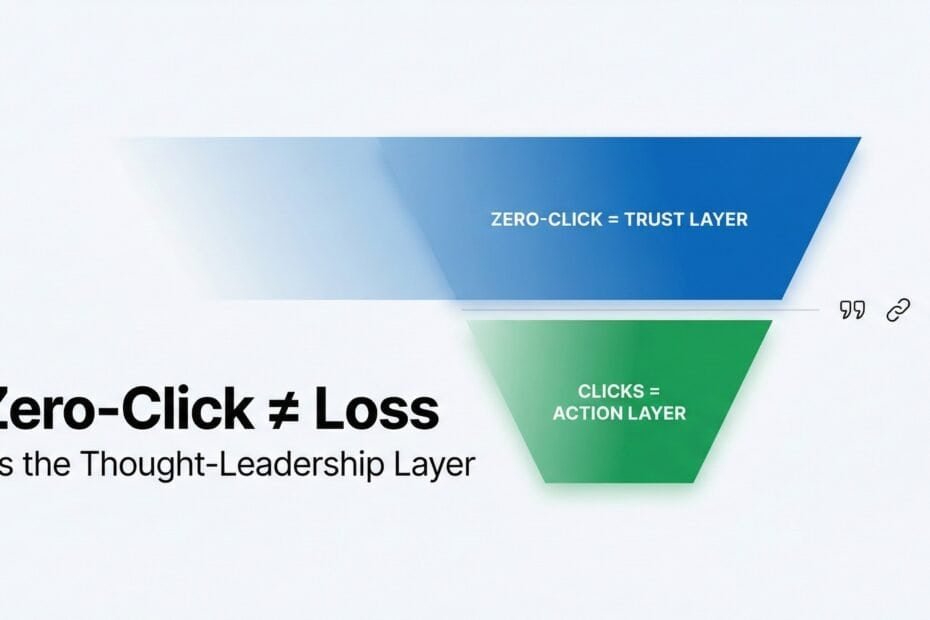
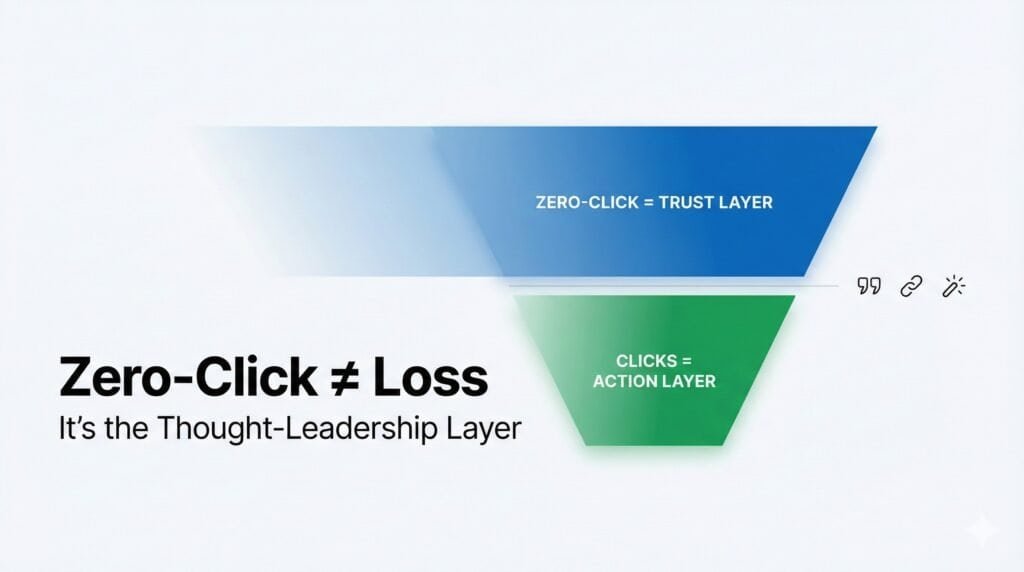
Zero-Click is the trust layer; clicks are the action layer. The winning strategy is building both.
Search Has Shifted from Retrieval to Resolution
Until recently, searches were about finding links. Today, search systems behave more like resolution engines:
- They extract meaning.
- They synthesize answers.
- They infer user intent.
- They present conclusions, not just links.
This includes:
- SEO (Search Engine Optimization)
- AEO (Answer Engine Optimization)
- AIO (AI Overview Optimization)
- GEO (Generative Engine Optimization)
So the question changes from: “How do I rank?” to “How do I get quoted, cited, referenced, and trusted inside the answer layer?”
A Practical Framework for Businesses (GEO + AEO + AIO Strategy)
Businesses should optimize for three outcomes:
- Being cited in AI environments (GEO/AIO readiness).
Write clarity-first, definition-strong content with a neutral, explanatory tone. - Being selected inside answer panels (AEO readiness).
Use clean structure: headings, lists, definitions, and consistent terminology. - Being remembered as a thought-leader (authority readiness).
Create work worth quoting — frameworks, not filler.
Method (How we test visibility without pretending it’s permanent)
Controlled query set: We maintain a short list of high-intent queries (10–30) tied to our assets (Guide + Glossary).
Check environment: Incognito / not-logged-in, location pinned, same device class (desktop/mobile), and we repeat checks on different days.
What we record: (1) whether the brand/asset is cited, referenced, or paraphrased, (2) where it appears (AIO/answer panel/web/image), (3) screenshots + date stamps.
What we do not claim: This is not a guarantee of permanence. It’s an evidence trail that our content is eligible for the answer layer.
Case Study 1: Content Marketing Master Guide (BusinessKrafts)
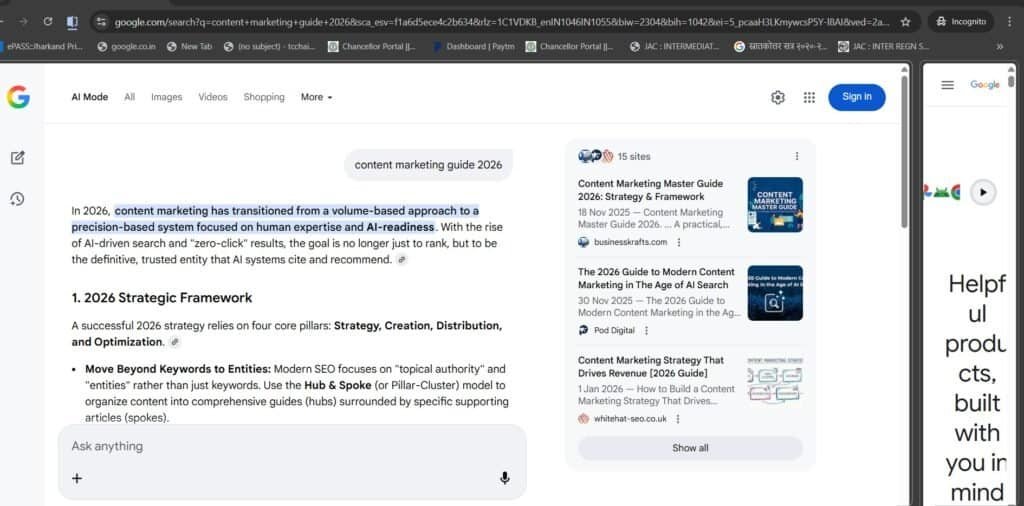
Our Content Marketing Master Guide 2026 has shown an interesting pattern in our repeated checks:
It has surfaced in AI-led answer environments across repeated checks, even when standard rankings fluctuate.
It demonstrates answer-layer trust and reinforces brand identity as a strategic authority. Even where SERP positions fluctuate, AI interfaces may still:
- pull meaning from it
- quote or reference core ideas
- infer you as a reliable source
In AI-led summaries, the guide’s frameworks are often paraphrased rather than copied, a strong sign that the system is using the underlying reasoning, not just the keywords. This is not accidental. It reflects:
- ✓ depth
- ✓ structure
- ✓ semantic completeness
- ✓ clarity
- ✓ conceptual coherence
This suggests a simple rule: AI-led interfaces tend to select sources that explain clearly, not sources that merely amplify noise. And our guide explains the subject in a way that both machines and humans can use.
Case Study 2: SEO Glossary 2026 (BusinessKrafts)
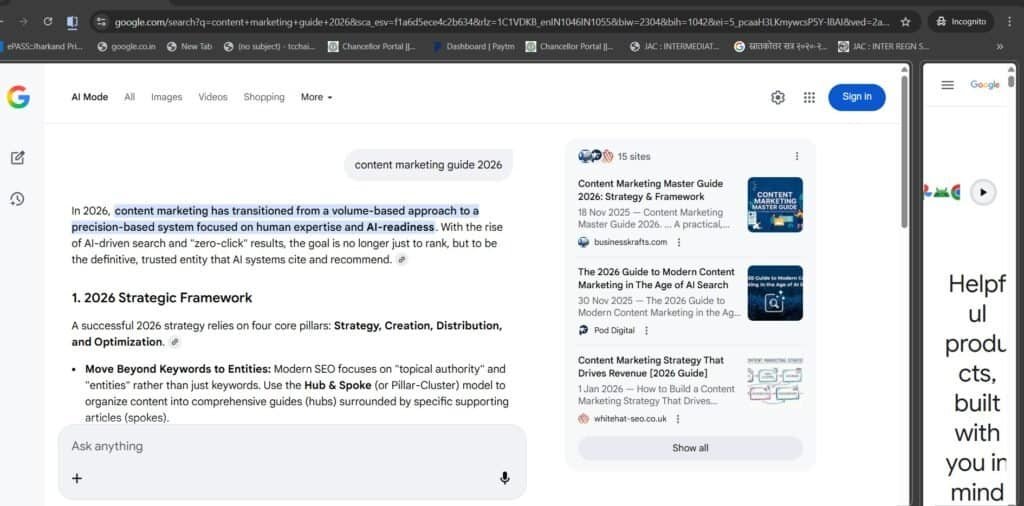
Our SEO Glossary 2026 is another strong example. Even during SERP fluctuations, three things showed up in our repeated checks:
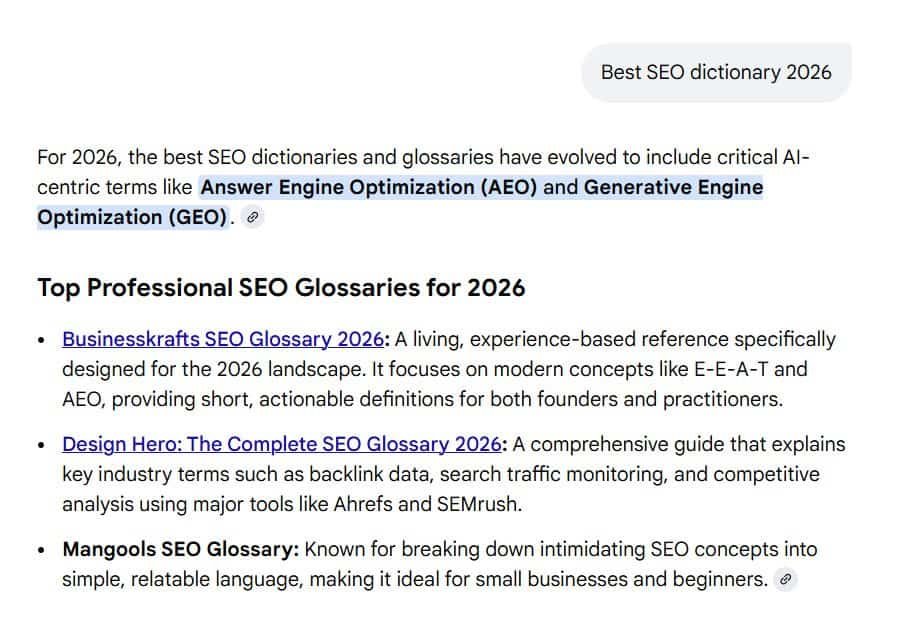
Across repeated checks, AI interfaces have used it as an explainer source (AIO/answer summaries and related surfaces), which is the behavior you want from a reference asset.
It appears in AI search environments as a trusted explainer and ranks in Image Search & standard web results for glossary-related queries.
When a glossary starts being used as an explainer across different interfaces (web, AI, and image), it behaves less like a “page” and more like a reference system. It demonstrates that authority is no longer page-level; it is concept-level.
AI-led systems often select for:
- precision
- neutrality
- clarity
- structure
- internal coherence
Our glossary meets these attributes, which is how it can start behaving like a “knowledge node” in these systems. This is GEO-readiness in action.
The Core Insight: Zero-Click Is the New Top-of-Funnel Trust Layer
Traditional funnel logic looked like this: Awareness → Click → Landing Page → Conversion. However, awareness is now also happening within search results and AI environments. The new reality is simple: trust happens before the click. And often, trust develops without the need for a click. This is not a downgrade, but a promotion. It really means:
✔ Your brand is present
✔ Your voice is visible
✔ Your definitions shape reality
✔ Your concepts inform understanding
✔ Your authority compounds silently
And when users do need deeper interaction, your brand is already the default recall-choice. This also aligns with a common pattern many teams observe: Users who click often arrive warmer, faster, and more ready to convert, because trust has already happened.
Why Most People Misread Zero-Click
Many marketers view Zero-Click as:
- Traffic loss
- Attribution gap
- Unfair competition
- Erosion of control
But these are distribution changes, not value destruction. The real question is: Is your brand visible in the answer, or invisible while others shape meaning? Because someone will always be shaping meaning. If it isn’t you, it will be someone else, often a competitor.
Zero-Click Benefits You, If You Do This
In many current interfaces, Zero-Click seems to reward:
- depth, not fluff
- clarity, not word count
- structure, not decoration
- authority, not noise
That is why our Content Marketing Guide and SEO Glossary 2026 have appeared in AI search environments, answer engines, and AI Overviews during repeated checks. The reason is clear: They were written for meaning, not just ranking. And meaning can be more reusable across interfaces, even when ranking mechanics shift.
Why This Matters for the Future of Brands
AI search environments do not replace brand strategy. They amplify strategic truths:
- Brands built on thin content often struggle to hold attention across AI-led surfaces.
- Brands built on depth, thinking, clarity, and meaning are more likely to be used as explainers.
So the strategic takeaway is simple:
- Clicks create revenue
- Zero-Click creates a reputation
And reputation can be more durable than any single algorithm cycle.
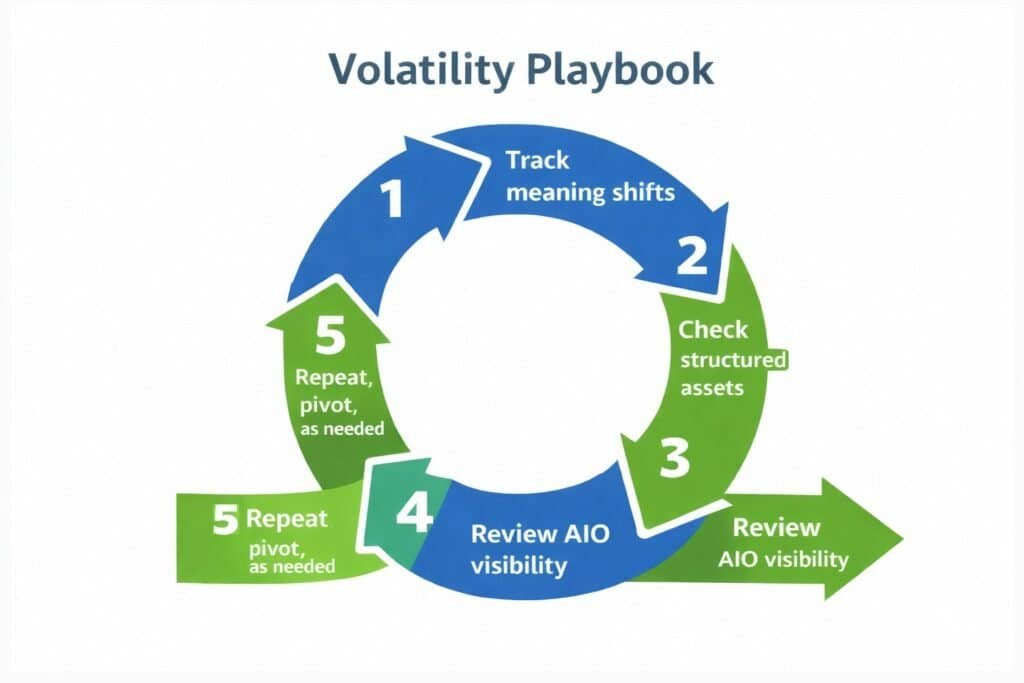
Volatility Playbook: How to stay steady when AIO surfaces change
- Own an evidence trail: maintain an Observation Log (queries, screenshots, dates).
- Build an owned audience: email, WhatsApp, community, so authority converts even if one surface drops.
- Design reference assets, not posts: glossaries, guides, checklists, definitions—things answer engines reuse.
- Refresh rhythm: lightweight monthly/quarterly updates so pages remain current and “alive.”
- Multi-surface readiness: write for web + AIO + image with consistent structure and definitional clarity.
How to Measure Zero-Click Value (Brand Recall + Assisted Conversions)
Zero-Click value is real, but it rarely shows up as “one clean metric.” You measure it through signals of recall and signals of assisted action.
1) Brand Recall Signals (people remember you before they click)
Track these month-over-month:
- Branded search growth: impressions and clicks for queries containing your brand name (and branded variations).
- Direct traffic and returning users: increases often reflect recall and repeat intent, not random discovery.
- Homepage / key guide entry spikes: users typing or navigating directly to your authority assets.
- Lead quality shift: more “I found you while researching…” conversations, fewer cold leads.
- Mentions and citations: references across platforms, communities, and AI-led summaries (even when clicks are low).
2) Assisted Conversion Signals (Zero-Click influences the path, not the last click)
Look for patterns where users convert after multiple touches:
- Conversion paths: organic discovery → return visit → conversion (often via direct, email, or referral).
- Longer consideration windows: high-trust topics convert more slowly; Zero-Click works like pre-selling.
- Micro-conversions that precede leads: time on page, scroll depth, PDF/guide opens, WhatsApp clicks, email signups, “Contact” page views.
3) Practical Tracking Methods (simple and defensible)
Separate brand vs non-brand reporting: track both, but interpret brand as the “authority meter.”
Define 2–3 primary conversions: inquiry form, WhatsApp/call clicks, consultation booking (whatever you use).
Measure assisted value: evaluate conversion paths and returning visits around those conversions, not just last-click attribution.
Keep a small query log for AI visibility: a controlled list of high-intent queries where you check whether your ideas/brand appear in AI-led answers. Over time, that log becomes evidence of “share of explanation,” not just rank.
Monthly Authority Scorecard (simple, stakeholder-friendly)
Track six numbers monthly:
- Branded impressions (GSC)
- Branded clicks (GSC)
- Returning users (GA4)
- Direct sessions (GA4)
- Assisted conversions (GA4 path exploration)
- Observation Log count (how many priority queries show your brand/ideas in answer surfaces)
The key interpretation rule: If branded searches, returning users, and assisted paths rise while overall clicks fluctuate, Zero-Click is likely building authority and pulling users closer to conversion, even when the “first click” is missing.
The BusinessKrafts Philosophy: Thought-Leadership as a System
BusinessKrafts is fundamentally strategy-driven. We don’t treat these shifts as “tactics to sell fast,” but as signals to refine how brands communicate meaning, trust, and usefulness in AI-mediated discovery.
Our work across Healthcare Offers, Healthy75, BusinessKrafts, SEO Glossary 2026, Content Marketing Guide, and 150+ clients’ projects shows a consistent principle:
Authority = clarity × structure × consistency × depth. Zero-Click simply made this visible. And that’s why our assets may surface. Not by luck, but because they are designed for meaning.
This principle has remained consistent across industries, platforms, and algorithmic shifts, including the transition from traditional search to AI-mediated discovery.
Zero-Click Is Not the Enemy; It is a Test.
Zero-Click Search asks one question: “If users never clicked, would your content still matter?” If the answer is yes, then Zero-Click becomes your stage, your proof-space.
Your thought-leadership layer and your work suggest this is possible.
The advantage goes to brands that do not merely rank, but shape meaning before the click ever happens.