1. Purpose Statement: Why This Page Exists
Growth in the digital economy has become increasingly fragmented. Businesses operate across multiple channels, platforms, tools, and AI-mediated environments, often without a unifying logic that explains why those efforts exist or how they connect. As a result, execution frequently precedes understanding, and activity replaces intent.
This page exists to document a strategy-led approach to growth, one that treats growth not as a collection of tactics, but as a system built on clarity, structure, and long-term compounding decisions. It is not a services pitch, a campaign page, or a promotional summary. Instead, it functions as a framework reference that explains how BusinessKrafts approaches growth as an integrated discipline.
At its core, strategy-led growth recognizes a simple principle: strategy exists before execution. Tools, channels, content formats, and automation methods are expressions of strategy, not substitutes for it. When strategy is absent or implicit, growth becomes reactive and unstable, especially in environments shaped by AI systems and meaning-based search.
This page serves as a conceptual anchor, explaining the thinking that informs execution, the structure that governs decision-making, and the system through which growth is designed, evaluated, and refined over time.
2. Why “Strategy-Led” Matters in 2026
In 2026, the mechanics of digital growth have shifted in fundamental ways. AI-generated content has reached saturation levels, automation tools have lowered execution barriers, and visibility is increasingly filtered through systems that evaluate meaning, coherence, and trust rather than surface-level optimization. As a result, competitive advantage is no longer created by volume or velocity alone, but by structural consistency across signals.
In this environment, tool-first growth models struggle. Agencies and vendors that prioritize tools, platforms, or channels before defining strategic intent often produce high volumes of activity with diminishing returns. Acceleration without direction creates noise, not advantage.
Execution-only models also fail under modern search and discovery systems. As large discovery platforms evolve toward interpreting intent, relevance, and credibility, growth strategies that rely solely on keyword targeting, automation speed, or isolated campaigns become structurally fragile. Visibility is no longer awarded for presence alone, but for coherence across signals.
A strategy-led approach addresses this shift by placing direction before acceleration. It asks foundational questions, who the brand is for, what problem it owns, and why it should be trusted—before selecting channels or deploying tools. In doing so, it aligns execution with systems that increasingly reward consistency, clarity, and long-term authority.
3. What Strategy-Led Growth Actually Means
The strategy-first approach is a structured system for building visibility, trust, and demand by aligning execution with clearly defined intent, structure, and long-term objectives. This approach is not a methodology or a checklist. It is a way of organizing growth decisions so that execution reinforces meaning rather than obscuring it.
At BusinessKrafts, this approach rests on three core principles.
3.1 Strategy Comes Before Channels
Strategy defines the boundaries within which growth operates. It clarifies who the brand is for, what problem it exists to solve, and why it deserves attention in that space. These decisions shape positioning, messaging, and priorities long before any channel is selected.
Channels, such as search, content, paid media, or social platforms, are therefore outputs of strategy, not inputs. When channels drive strategy, growth becomes reactive and fragmented. When strategy leads, channels serve a defined purpose within a broader system.
3.2 Growth Is a System, Not a Campaign
The strategy-led approach treats visibility, trust, and conversion as compounding outcomes, not campaign-based wins. Assets are designed to reinforce one another over time: content informs data, data refines positioning, and refined positioning strengthens future execution.
This systemic view explains why short-term hacks and isolated tactics fail under AI-driven indexing and discovery. Systems favor consistency and reinforcement, whereas campaigns optimize for temporary spikes. Sustainable growth emerges from feedback loops, not bursts of activity.
3.3 Execution Must Be Interpretable by Humans and Machines
Modern growth operates in a dual-audience environment. Execution must be clear to human users while remaining interpretable by machine-driven systems that organize, summarize, and rank information.
This requires clarity in messaging and intent, structured information that reflects logical hierarchy, and semantic consistency across content, pages, and signals. When execution aligns with these principles, it becomes resilient to changes in tools and platforms. Meaning remains stable even as mechanisms evolve.
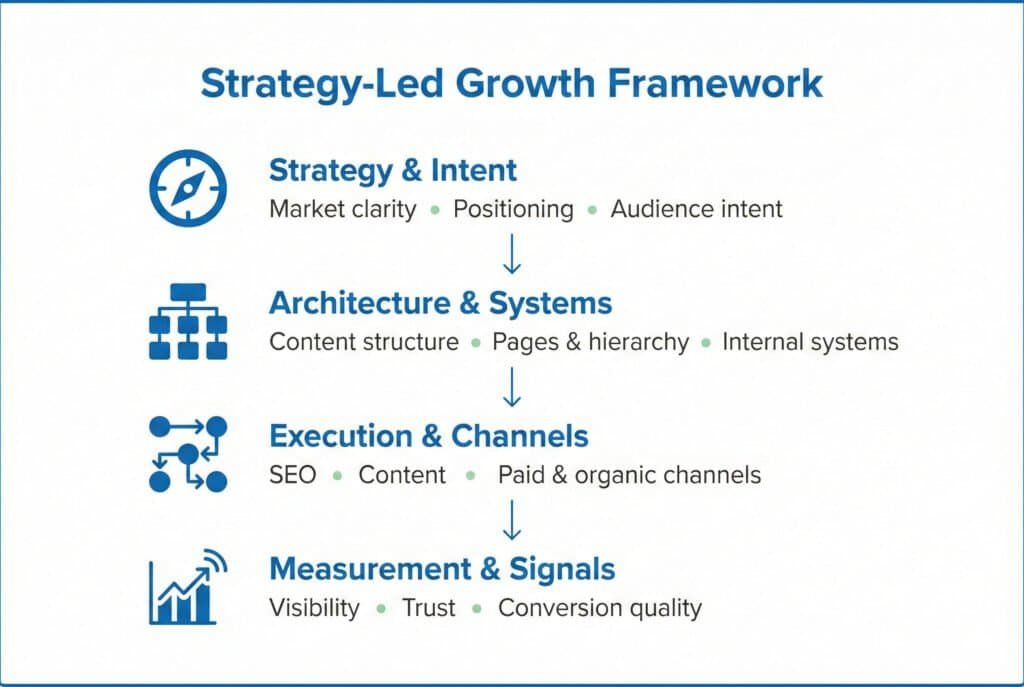
4. The BusinessKrafts Growth Framework (High-Level)
The framework described here requires structure. Without a clear framework, strategy remains theoretical and execution becomes inconsistent. The BusinessKrafts approach organizes growth into four interdependent layers, each serving a distinct role while reinforcing the others.
This framework is intentionally non-tactical. It explains how growth is structured, not how individual tasks are performed.
4.1 Foundation Layer – Market & Meaning
The foundation layer defines why growth should occur in a particular direction.
It begins with market understanding: identifying the category context, competitive landscape, and unmet needs that shape demand. This is followed by audience intent analysis, understanding not just what people search or click, but why they do so and what decisions they are trying to make.
From this emerges positioning clarity, supported by strategic branding that defines meaning before messaging. Positioning is not messaging or branding in isolation; it is the strategic decision about what the organization stands for, what problem it owns, and where it does not compete. All higher layers depend on the stability of this foundation.
4.2 Architecture Layer – Content, Pages, Systems
Once meaning is defined, it must be expressed through structure. The architecture layer translates strategy into organized information systems, including scalable website design and development that supports clarity, hierarchy, and long-term reuse.
This includes:
- Clear information hierarchy across pages and assets
- Content ecosystems designed for depth, continuity, and reuse
- Internal linking logic that reflects conceptual relationships rather than navigation convenience
Architecture determines whether growth assets compound or fragment. When content, pages, and systems are aligned, they reinforce one another over time. When they are isolated, visibility can be volatile.
4.3 Execution Layer – Channels & Automation
Execution occurs only after foundation and architecture are established. Channels are selected based on strategic fit, not popularity or trend.
This layer includes:
- Search visibility initiatives, including local SEO, where geographic intent and trust signals matter.
- Content creation and distribution over different channels, including social media marketing.
- Paid and organic amplification, including PPC advertising aligned with strategic demand signals.
- AI-assisted workflows that are used to support scale and consistency.
Automation is treated as an accelerator, including email automation that reinforces timing, relevance, and continuity. But it is not a substitute for thinking. Tools are integrated to serve predefined objectives, ensuring that speed does not come at the cost of coherence.
4.4 Measurement Layer: Signals, Not Vanity Metrics
Measurement in this model relies on analytics and reporting to evaluate visibility consistency, trust indicators, and conversion quality; rather than prioritizing surface metrics, this layer evaluates:
- Visibility consistency across time
- Trust indicators reflected in engagement and discovery
- Indexing and crawl behavior
- Conversion quality rather than volume
These signals provide feedback to earlier layers, allowing the strategy to be refined without destabilizing execution.
5. Strategy-Led vs Vendor-Led Growth
The difference is not philosophical; it is operational. The distinction between strategy-led and vendor-led growth is structural, not stylistic.
Vendor-led models prioritize delivery. They focus on completing tasks, deploying tools, and reporting activity within predefined scopes. While this approach can produce short-term outputs, it often lacks compounding value because decisions are made in isolation.
This strategy-first model prioritizes framework ownership over tool dependency, rather than tool-driven execution. Instead of optimizing for immediate activity, it optimizes for coherence across time. Decisions are evaluated based on how they strengthen the overall system, not just the current campaign.
This difference becomes more pronounced in AI-influenced discovery environments, where fragmented execution struggles to maintain relevance. A deeper exploration of this contrast is documented in the internal reference on strategy-led agencies versus vendors, which expands on how structural thinking influences long-term outcomes.
6. How This Strategy Connects to Our Services
Execution follows strategy. The services offered by BusinessKrafts exist to apply the framework described above, not to replace it.
- Within this framework, market research supports the foundation layer by clarifying demand, competition, and audience intent before decisions are made.
- Within this framework, strategic planning translates insights into positioning, priorities, and directional clarity.
- Content Marketing operationalizes architecture by building interconnected assets designed to compound over time.
- SEO aligns execution with discovery systems by reinforcing structure, relevance, and interpretability.
- Growth Systems integrates channels, automation, and measurement into a cohesive operating model.
These services are interconnected. Engagement begins only after strategic alignment is established, ensuring execution strengthens the system rather than fragmenting it.
7. Proof Without Promotion (Trust Clarification)
BusinessKrafts’ work has not followed a continuous public visibility cycle. For several years, growth strategy, content systems, and digital execution were delivered in private enterprise engagements, primarily within regulated and high-stakes environments where public attribution was neither required nor appropriate.
This work spanned multiple years and focused on system design, content architecture, and long-term visibility rather than short-term acquisition.
Public re-engagement began in 2025, with a deliberate shift toward documentation rather than promotion. Instead of retrospective claims, the focus has been on publishing verifiable frameworks, long-form guides, and case-based explanations that demonstrate how the strategy-led growth framework is designed and applied in real contexts.
This page is part of that documentation effort. It exists alongside openly accessible research assets, strategic guides, and structural references that allow readers and external evaluation systems to assess consistency, depth, and intent over time. No individual page stands alone; trust is established through continuity across the knowledge base.
8. How to Use This Page
This page is intended for readers who are evaluating growth beyond tactics.
- Founders and decision-makers can use it to understand how strategic clarity precedes execution and why growth systems fail without structural alignment.
- Researchers and evaluators can treat it as a framework document that explains how strategy-led growth is defined and structured, independent of tools or trends.
- Marketing and strategy professionals can reference it as a conceptual model for organizing content, channels, and measurement into a cohesive system.
Readers looking for a deeper application can move next to documented guides, the SEO and AI-search glossary, or service-specific pages that apply this framework in practice. The sequence matters: understanding first, execution later.
9. Strategy Is the Asset
Tools change, platforms evolve, automation accelerates, and strategy endures.
In environments shaped by AI systems, meaning-based discovery, and trust-weighted visibility, such as those operated by Google and similar platforms, growth without strategy becomes indistinguishable from noise. Activity alone does not compound; structure does.
This approach treats clarity as an owned asset. It ensures that execution reinforces intent, that systems remain interpretable over time, and that growth decisions accumulate value rather than fragment attention.
This page does not conclude a process. It defines the ground on which sustainable growth is built. In this sense, strategy is not a phase of growth; it is the condition that makes growth durable.