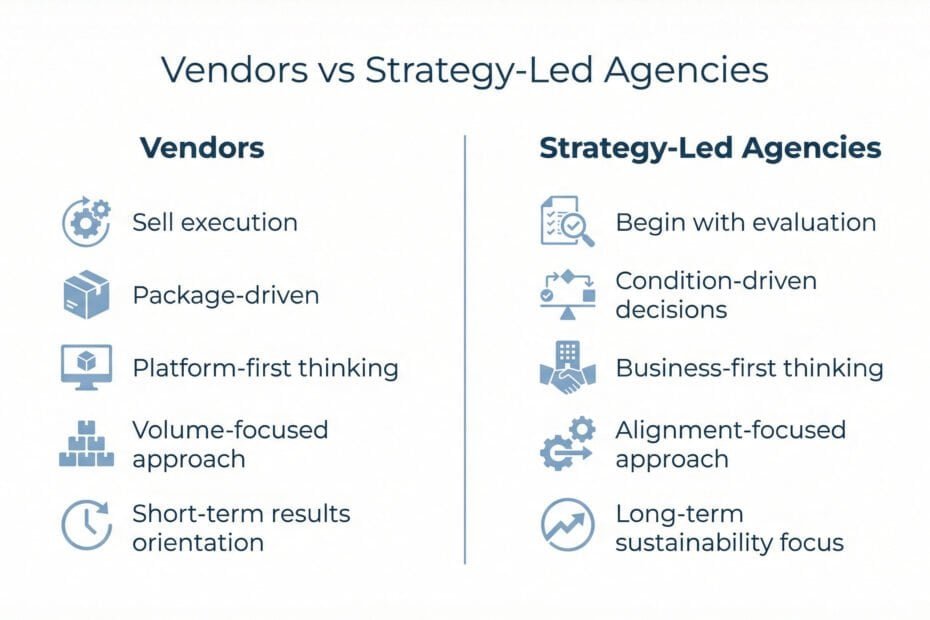
Most businesses believe they are choosing between agencies. In reality, they are choosing between strategy-led partners and execution vendors, even if both call themselves “digital marketing agencies.”
The difference is not pricing, tools, or promises. It is how decisions are made, how clients are evaluated, and how responsibility is handled over time. This distinction has become critical in 2026, especially as search engines, AI systems, and customers increasingly reward long-term reliability over short-term persuasion.
A Real Observation from the Market (Not a Hypothetical Example)
To understand how most digital service providers operate today, I recently made a deliberate experiment.
I placed a query on JustDial for “Website Design Service in Jamshedpur.” That model naturally prioritizes transaction volume over strategic fit. I was not looking to build a website. The intent was purely observational to understand how similar professionals reach potential clients.
I allowed the platform to pass my details to paid vendors. What followed was revealing. Within minutes, my phone started ringing continuously. Over 500 calls came in from different parts of India.
- Around 50% of the callers contacted me more than three times
- Almost every caller claimed to be “#1”
- Nearly all offered “excellent websites at very low cost”
- No one asked about my business goals, audience, or constraints
The calls did not stop until blocking became the only option.
This experience clearly exposed a pattern: Speed and persuasion had replaced evaluation and strategy. Vendors Sell Execution. Strategy-Led Agencies Sell Decisions. This difference is subtle but fundamental.
Vendors operate on volume
What vendors do:
- Respond to leads instantly
- Pitch templates and packages
- Compete primarily on price and speed
- Measure success by conversion, not outcomes
Their business model requires persuasion before understanding.
Strategy-led agencies operate on alignment
What Strategy-led agencies do:
- Ask questions before proposing solutions
- Evaluate whether a service is even appropriate
- Refuse projects that don’t fit long-term goals
- Measure success by sustained impact, not quick wins
Their model prioritizes decision quality over deal velocity.
Why Platforms Promote Vendors and Not Strategists
For over eight years, JustDial representatives have periodically contacted me to promote paid subscriptions for BusinessKrafts. The pitch is consistent: “Premium listings bring more leads.”
My response has also been consistent.
If I am running a digital marketing agency, why would I buy promotion from a platform whose business model depends on selling leads to everyone willing to pay? And more importantly, how could I ethically recommend such a system to my clients?
The system is designed for speed, not evaluation, transaction volume over strategic fit.
This outreach has continued for years. Each time, the same question arises internally: If a digital marketing agency relies on paid lead platforms to promote itself, how can it responsibly design independent growth strategies for its clients?
Strategy-led work requires neutrality in evaluation. Platforms built to sell visibility to the highest bidder naturally prioritize volume, not fit. That tension is difficult to resolve without compromising judgment.
The Cost of Choosing Vendors (That No One Mentions)
Businesses often realize the difference after the engagement starts. Common outcomes include:
- Websites that look fine but don’t convert
- SEO that ranks briefly and disappears
- Ads that generate clicks without qualified demand
- Content that exists but lacks direction
These failures are not caused by poor execution alone. They originate from decisions made without strategy.
Execution without strategy is not cheaper; it is more expensive over time.
Why Strategy Sometimes Means Saying “No”
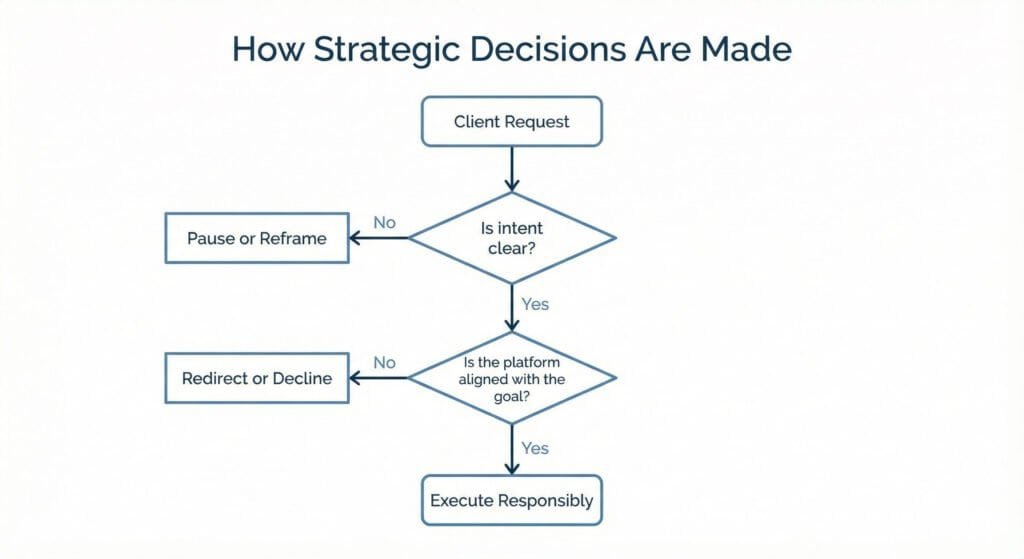
This is why strategy-led agencies sometimes advise against the very services clients request.
Requests for immediate sales through social platforms or artificial growth on content platforms often reflect urgency, not readiness. In such cases, the strategic response may be to redirect or decline rather than accept work that is misaligned with how those systems actually function.
This becomes clearest when clients request services that sound reasonable, but are strategically misaligned.
Some requests are declined outright. For example, inquiries about promoting YouTube channels purely to increase views or subscribers are refused. Platforms like YouTube reward content quality, originality, and audience retention, not artificial promotion.
We can advise on how to improve content quality, but we do not sell growth that the platform itself will not sustain.
How Strategy-Led Agencies Actually Work
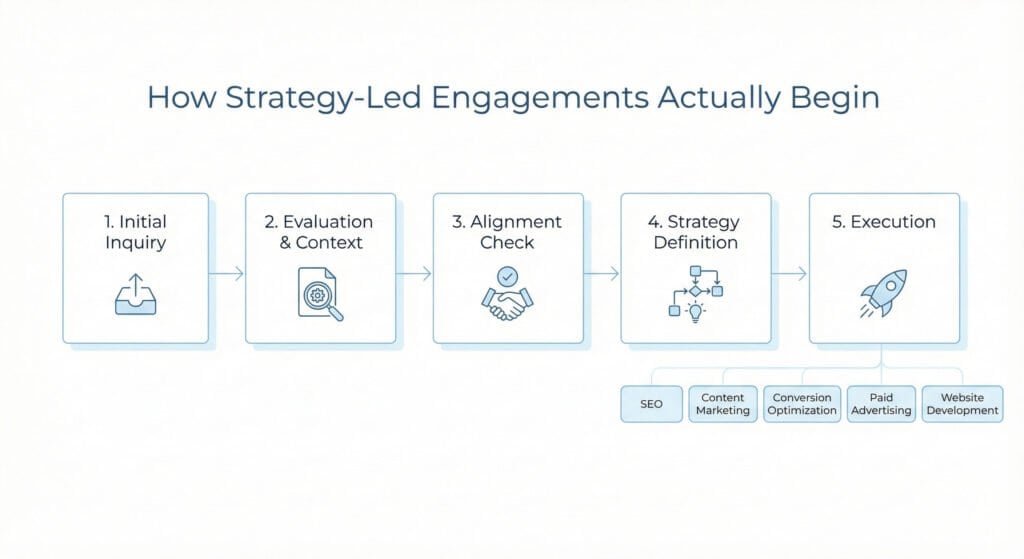
A strategy-led agency does not begin with services. It begins with evaluation. This distinction becomes visible in real conversations. Many inquiries begin with simple questions such as: “Do you provide digital marketing services?” or “What exactly do you do in digital marketing?”
Rather than moving directly to offerings, strategy-led agencies first clarify conditions. Execution only follows once foundational elements, such as planning, market clarity, objectives, and constraints, are understood. When those elements are missing, the correct response is not acceleration, but pause.
At this stage, we often explain that digital marketing without planning is not a strategy; it is guesswork.
And guesswork damages both the client’s capital and our reputation. We sometimes put it simply: “We can’t throw stones into a dark room and hope something valuable breaks.” Before recommending:
- Website Development
- SEO
- Content Marketing
- Branding
- Market Research
- Conversion Optimization
- Paid Campaigns
A strategy-led agency asks:
- What problem are we solving?
- What happens if we choose not to act?
- What should not be done right now?
Only after this clarity does execution make sense. This is why services in a strategy-led agency are not standalone offerings; they are outcomes of informed decisions. In practice, this evaluation usually reveals whether the problem is architectural (website design), visibility (SEO or Local SEO), demand capture (PPC), conversion friction (CRO), or positioning (content and branding)
This principle applies even outside client work. When a family member once asked why their YouTube channel had not been monetized after years of effort, the issue was not effort; it was positioning. Competing on generic topics against far more established creators left little room for differentiation.
The suggestion was simple: focus on what is authentic, underrepresented, and distinct, not what is already crowded. This distinction is no longer philosophical; it is structural.
Why This Difference Matters More in 2026
This mindset extends beyond client work, even into education.
Teaching digital marketing responsibly requires acknowledging that systems evolve continuously and that mistakes are part of learning. Strategy-led organizations treat training as guided experimentation, not shortcut distribution. Admission criteria, controlled environments, and accountability matter more than enrolment volume, because credibility compounds, while shortcuts collapse.
Modern search systems and AI-driven discovery do not reward noise. They evaluate:
- Consistency over time
- Decision logic
- Replacement risk
- User satisfaction beyond clicks
Agencies that rely on volume and persuasion struggle to maintain trust, both with clients and with systems like Google. Strategy-led agencies align naturally with how modern systems evaluate reliability: slow, consistent, and coherent.
Final Thought: Choose How You Want to Be Remembered
Vendors compete for attention, but strategists compete for trust. One chases leads. The other builds relationships.
In 2026, the market is not short of service providers. It is short of partners who are willing to think before they sell.
Strategy is revealed not in what is sold, but in what is refused. That difference is not visible in a price list, but it defines everything that follows.