Write a Business Plan You Can Actually Use
This guide grew from real questions people asked over the years about what a business plan is, why it matters, and how to write one without getting stuck.
Introduction: How This Guide Grew Over Time

Before I begin, let me say this: this guide wasn’t written overnight or because I sat down one morning and decided to publish a long article. It grew slowly, almost naturally, through the questions people asked me over the years. Entrepreneurs setting up their first venture, students preparing assignments, shop owners planning expansion – someone or the other would always ask:
- “What actually is a business plan? I mean, in simple words?”
- “Do I really need one?”
- “I’m starting next month… what happens if I don’t have a plan yet?”
- “Can you show me how to write one step by step?”
- “What should I include?”
- “Do you have a template for a business plan?”
These questions kept repeating, and after answering them individually so many times, it finally struck me that I should put everything together in one place. Something practical. Something easy to follow. Something you could refer to whenever needed – whether you jump straight to how to write a business plan step by step, revisit what a business plan really is, or skim the common mistakes to avoid.
So this updated guide is built around four simple pillars:
- What a business plan really is
- Why it matters more than most people think
- How to write one that actually works in real life
- What goes into a modern business plan today
I’ve added anchor links across major sections so you can move around freely. You may skip any part that you don’t need. This is not a textbook – you don’t have to read it line by line unless you want to. If you’re in a hurry, you might start with financial plans & projections or jump straight to the EcoBox case study to see a full business plan in action.
A lot has changed since I wrote the earlier version of this article four years ago. The way businesses operate today – remote teams, digital tools, global competition, AI-assisted research – has changed the meaning of planning itself. That’s why this edition is refreshed for 2025–2026. My hope is simple: that this guide helps you build a business plan that feels realistic, practical, and ready for today’s environment.
Whether you’re starting fresh, expanding a small enterprise, or reorganising an existing company, I believe you will find something here that saves you time, money, or a few avoidable mistakes. And if, after writing your plan, you need support with market research, strategic planning, or business consulting, you can always turn your written plan into a concrete roadmap for execution.
If you’d like to go deeper into business planning after this guide, you may also explore reliable references such as the U.S. Small Business Administration’s business plan overview , the Investopedia explanation of business plans , or long-form articles from Harvard Business Review on planning and strategy . This guide is written to sit beside those resources, not to replace them.
What Is a Business Plan?

A business plan, when you strip away all the jargon, is really a written explanation of what you intend to build and how you intend to build it. It is part research, part thought process, and part strategy. Some people think of it as a “formal document,” but it is often more useful to treat it as a working blueprint – something that evolves as your idea grows.
It gives you a realistic picture of your idea’s feasibility. It forces you to pause, think, question, and sometimes even rethink things you were certain about. That reflection alone is worth the effort, whether you are launching your first startup, expanding a local store, or formalising the plans you already carry in your head.
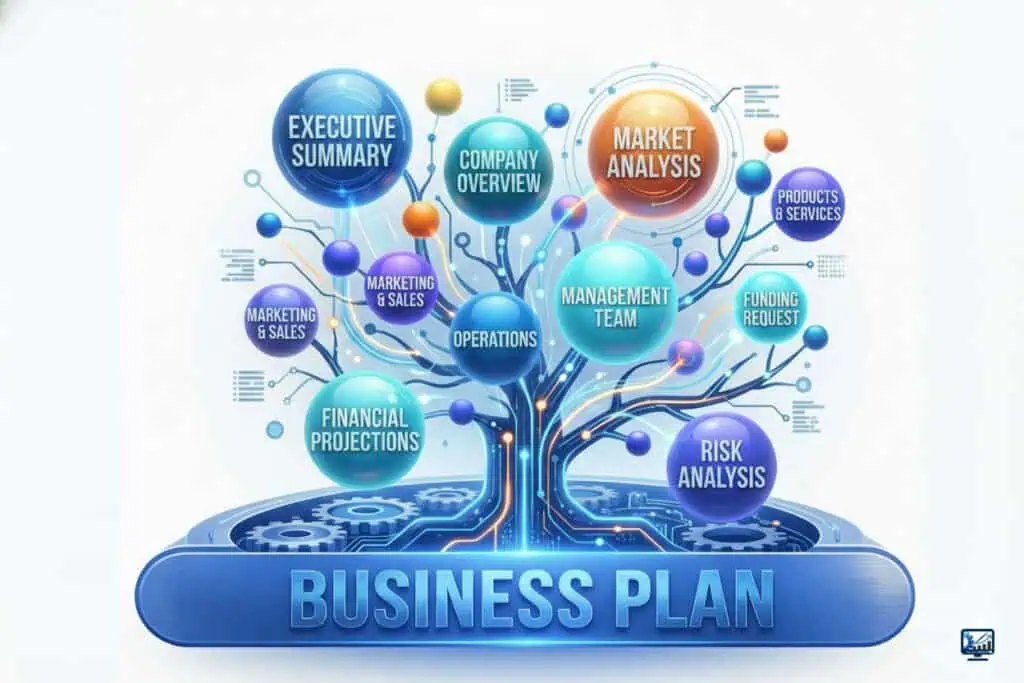
A full business plan usually includes several interconnected parts. In this guide, we’ll go through each one in detail, but here is the big picture:
- Executive Summary
- Introduction to the Business
- Business Model
- Business Goals
- Market Analysis – often supported by dedicated market research and customer insight.
- Products or Services
- Customer Profiles (buying personas)
- Competitor Analysis
- Business Structure
- Management Team
- Financial Plans – revenue, costs, cash flow and projections.
- Legal and Compliance Details
- Marketing Approaches – from brand positioning to digital marketing strategy .
- Milestones and implementation timeline.
- Appendix – supporting documents, research notes and references.
We’ll walk through each of these areas in later sections, showing you how they connect and how to keep them realistic. If you already have some of these pieces written in isolation – for example, a marketing strategy or a basic set of projections – you can gradually plug them into your plan rather than starting from a blank page.
Different organisations explain business plans in slightly different ways, but the core idea is the same. If you’d like another perspective while you read this guide, you can compare it with the U.S. Small Business Administration’s business plan outline or the practical templates offered by SCORE (the U.S. small business mentoring network) . Use whichever format helps you think clearly – the important part is that your plan is honest, usable, and updated, not that it follows a rigid one-size-fits-all template.
Why a Business Plan Is Important

Think of a business plan as a companion – not a document you create only when someone demands it. It helps you from the moment your idea is born, through the messy middle, and even when you scale or pivot. In that sense, it sits beside you the whole way, not in a folder that you open once a year.
Starting a business without a plan is surprisingly common. Many people rely on enthusiasm alone, and for a short time, it even works. But eventually, they hit a point where decisions become confusing. Costs start rising. Markets don’t respond as expected. People lose direction. I’ve seen this happen to more people than I can count – especially when there is no clear business model, no defined goals, and no written financial plan.
It’s not that their idea was bad. They simply didn’t have a roadmap. A business plan turns scattered thoughts into a sequence: where you are now, where you want to go, and what has to happen in between. That same roadmap later becomes a helpful reference when you work on marketing and sales, strategic planning , or business consulting with an external partner.
A business plan shouldn’t be something you prepare only for banks or investors. In fact, the first person it should convince is you. Before you pour money, time, and energy into a venture, your plan forces you to ask hard questions:
- Is this idea strong enough for the market I’m entering?
- Am I prepared for the costs, risks, and execution challenges?
- What am I not seeing yet – and how can I test it before I commit fully?
The value is in the thinking, not just the writing. When you write your plan, you slow down enough to see gaps, assumptions, and blind spots. That might lead you to adjust your customer profile, rethink your pricing model (we’ll cover this within the financial plans section), or change the way you plan to reach customers entirely.
Research over the years has consistently shown that structured planning improves the chances of business survival and growth. If you’re curious, you can compare this guide’s approach with resources like the U.S. Small Business Administration’s planning guide or articles from Harvard Business Review on business planning and execution . Use them as additional lenses – but keep your own written plan at the centre of your decision-making.
How a Business Plan Helps You
Here’s how a good business plan quietly supports you long before anyone else reads it:
- It tests whether your idea actually works
You move from “I think” to “I know” because research gives you evidence. See Market Analysis and the Business Model part of your plan. - It helps you set and refine your strategies
You learn why certain decisions make sense and why some don’t. This ties closely to Marketing & Sales Strategy and Pricing Model. - It reveals risks early
You solve problems on paper before spending real money. This thinking connects forward to Financial Planning. - It clarifies your growth path
Goals become measurable and realistic, not vague dreams. See the Milestones section for how to express them in your plan. - It strengthens your understanding of your market
You know your customers, competitors, and positioning better. This links forward to Customer Profiles and Competitor Analysis. - It keeps you focused on returns
A plan reminds you which efforts lead to real results and which are distractions. This ties later into Sales Structure.
Importance for Investors and Financial Partners

When you share your idea with someone outside your immediate circle – a banker, investor, or potential business partner – the first thing they look for is the business plan. Because it quickly shows how deeply you’ve thought things through.
A well-written plan tells them quietly, without a pitch:
- “Yes, this idea actually makes sense.”
- “The numbers add up, at least on paper.”
- “The founder understands what they’re walking into.”
Investors don’t fund excitement. They fund preparedness. A structured plan becomes a trust signal. If you want additional references on this topic, you may view insights from Harvard Business Review on startup preparedness or browse global interpretations on funding confidence from Investopedia, and partner your thinking later with data groundwork such as market research services as I provide forward examples in this article.
Summary: Why You Need a Business Plan
In short, a business plan helps you:
- Understand why you want to do this business
- Write your idea in a way that makes sense even to a stranger (see: Executive Summary)
- See gaps early (jump later to: Mistakes to Avoid)
- Get a real market picture (see: Market Analysis
- Outline logical growth (preview: Milestones)
- Give investors concrete material to evaluate (Financial Plans)
In short, it becomes your steady companion. It won’t do the work for you, but it keeps your thinking organised so you can execute the next steps clearly.
How to Write a Business Plan (Step-by-Step)

Writing a business plan takes patience. It’s not the sort of thing you finish in one sitting – and honestly, it shouldn’t be. You need time to think, compare ideas, and question yourself here and there. A good plan becomes your backbone; it steadies you when things get confusing or overwhelming.
Here’s a simple way to approach it. We’ll walk through each of these in detail:
- Do your research
- Set goals
- Know who will read the plan
- Keep it to the point
- Maintain a consistent writing style
- Build a clear company profile
- Document every essential part of your business
1. Do Adequate Research
Research is what keeps your business plan grounded in reality. No matter how passionate you are about your idea, research helps you check whether the outside world agrees with you – or not.
Good research helps you:
- check if your idea stands a chance in the real market,
- understand who your competitors are and how they position themselves,
- notice trends you hadn’t thought about,
- identify your target customers in more detail, and
- create strategies based on facts instead of wishful thinking.
This step connects directly to your future Market Analysis, Customer Profiles, and Competitor Analysis sections, and it is the foundation of a realistic business model.
Informal Research
This is how almost everyone starts. You talk. You discuss the idea with colleagues, friends, mentors, past customers, or anyone who understands the industry even a little. They give you raw, unfiltered responses that can immediately show you what you’re missing.
These conversations won’t go into the plan word-for-word, but they shape your thinking. They help you answer simple questions like:
- “Does this sound useful to you?”
- “Would you pay for something like this?”
- “What worries you about this idea?”
As you collect informal feedback, keep notes. Later, when you write your Executive Summary or refine your Products & Services section, these early conversations will help you avoid building something nobody really wants.
Formal Research
Once you’ve absorbed these early reactions, it’s time to move to more structured research. This is where your plan becomes serious and where you start gathering evidence you can actually quote or reference:
- online research and industry reports,
- simple surveys or polls,
- short questionnaires shared with potential customers,
- interviews with people already in the field,
- mapping your competitors and their offerings,
- reviewing pricing, positioning, and reviews of similar products, and
- using AI-supported tools for keyword trends and demand signals.
Some of this can be done on your own. For deeper work – especially if you are entering a new or competitive market – you may want help from a market research partner or analytics and reporting service to validate your assumptions with data, not just intuition.
After you gather everything, organise it. The full research file – survey responses, screenshots, notes, and reports – can sit separately in a folder. Your business plan should only highlight the insights that actually shaped your key decisions: your target customers, your model, your pricing, and your go-to-market approach.
If you want structured examples of how research feeds into a business plan, compare this approach with the sample plans provided by the U.S. Small Business Administration (market research & competitive analysis) or the free business plan templates from BDC (Business Development Bank of Canada) . They follow different formats, but all rely on the same foundation: solid research.
2. Set Clear Goals
Goals are there so you don’t drift. They tell you what you’re trying to achieve and help you measure whether you’re moving in the right direction. A founder without goals keeps reacting to events; a founder with goals starts shaping them. Later in this article, you can link your goals to financial planning and milestones for execution clarity.
Use the familiar SMART framework – Specific, Measurable, Achievable, Relevant, and Time-Bound. It may sound like a management textbook idea, but it genuinely works. If you’d like another global perspective, you may compare with frameworks discussed in Harvard Business Review on strategic planning and the goal-setting material from SCORE SMART goals templates.
Examples
- “Get 1,000 paying customers within 12 months.”
- “Reach break-even in 18 months.”
Inside your plan, clearly state:
- What you want
- How much you expect
- When you want it
And remember – goals change. They get updated. Sometimes they shrink; sometimes they expand. A business plan is not a stone tablet. It’s more like a chalkboard you are allowed to rewrite.
When your goals need refinement using data, consider pairing this step later with analytics & reporting for measurable tracking, or strategic planning support for structured roadmaps.
3. Know Your Audience
Your plan might pass through several hands: investors, banks, future partners, advisors, sometimes even regulators. Each reads the plan with a different intention. Investors want growth and scalability. Bankers want stability and repayment confidence. Partners want clarity of roles and alignment. Regulators want evidence of compliance.
So while drafting, try to imagine who will read your plan and what questions they might silently carry into the room. If you want global insights into how reader intent varies, check essays on audience psychology in planning from Investopedia and planning communication principles from Harvard Business Review.
4. Keep It Concise
A business plan should be detailed, but not tiring. Most good plans fall somewhere between 10 and 30 pages. Too short lacks depth. Too long loses attention. Extra charts, long explanations, or stacked screenshots should live in your appendix, keeping the main narrative clean.
If you’re curious how concise executive communication improves funding outcomes, refer to global data-backed writing on brevity from HBR on Leadership & Communication and startup plan structure suggestions from BDC on Business Strategy.
Return Focus & Fact Tracking
A plan keeps you focused on returns. It stops you from draining money and energy without measuring impact. Later, while writing your financial plans, connect your costs, CAC, lifetime value, and funnel efficiency to see what actually converts.
For keyword trend validation and demand forecasting, founders commonly explore AI-driven tools such as Google Trends or industry mapping via reputed strategy indexes on Statista. These may sit beside your own plan’s narrative.
Market Understanding & Positioning Confidence
Building a plan deepens your understanding of market size, segmentation, trends and positioning. When you want validated data for this stage, tie it later with professional Market Research, Strategic Planning, Analytics & Reporting, and .
Globally, founders validate positioning using tools like CB Insights – Startup Failure Research, which reinforces why structured planning is an early-stage advantage, not bureaucracy.
5. Maintain a Consistent Tone and Style
Write simply and clearly. You don’t need fancy language or heavy corporate jargon. People trust clarity more than polish. A steady voice across sections like your Financial Plans or Market Analysis makes the plan feel professional and well-prepared — without exhausting the reader. If writing isn’t your strength, consider help from content experts. There’s no shame in it; founders who communicate clearly often move faster in execution.
For writing confidence built on real founder communication patterns, see: HBR on Founder Communication Tone .
6. Create a Company Profile
Your company profile tells the reader who is building this business and why they should trust the plan. It becomes a quick grounding place for anyone new. Done right, it supports your pitch quietly when investors revisit information, and it works alongside services like Branding, Business Consulting, and Strategic Planning.
A strong profile typically includes:
- Short introduction
- Vision & Mission statements
- Background & context where applicable
- What you offer (products/services)
- Target market & audience
- Core strengths, resources & differentiators
Because people often return to this section mentally or in discussion, writing it clearly early saves time later — especially when aligning teams.
For global small-company profile lens, benchmark against: SCORE Business Profile Examples .
7. Document All Aspects of Your Business
A business plan should feel like a complete working blueprint. Transparency builds reader and investor confidence. As you expand this guide, you’ll later attach details on Operations, Management, Finances, and Marketing.
Capture essentials such as:
- Operations & processes
- Management & people responsibilities
- Financial structure (costs, revenue, cash flow)
- Marketing approaches & channels
- Distribution methods
- Location strategy or remote model
- Technology stack and tools used to deliver services
- Legal and compliance considerations
- Milestones and execution sequence
If you treat this stage seriously, you’ll realise the plan gradually becomes more important than excitement alone. This thinking connects naturally forward to future feasibility checks in the Financial and Competitive sections.
Industry research reinforcing transparent business planning advantage from global lens: CB Insights: Why Businesses Fail Without Structure .
Up Next in This Guide
Continue your drafting journey:
Crucial Components of a Business Plan
Customer Profiles (Buying Personas)
When you start thinking about your customers, it helps to picture real people instead of vague categories. A buying persona is simply a description of the kind of person who’s most likely to buy from you. Instead of throwing random marketing ideas into the air, you try to understand who you’re talking to.
You might include details such as:
- their age, income, education, or where they live,
- how they behave as buyers – do they compare prices, read reviews, or shop impulsively?
- any cultural or regional habits that influence their choices,
- what they can realistically afford,
- the problems they’re dealing with or the frustrations they want solved, and
- most importantly, why they’d pick you instead of dozens of other options.
A clear customer persona saves you from guessing later. Marketing becomes easier, and so does your messaging. You know exactly whom you’re speaking to. This becomes the backbone of your Marketing & Sales Strategy and aligns well with content marketing, SEO, and social media marketing work.
For extra reference, you can compare your personas with guides from HubSpot’s buyer persona resources or research-based persona examples shared by Nielsen Norman Group .
Competitor Analysis
Understanding your competitors isn’t about feeling intimidated; it’s about knowing where you stand in the landscape. Every business has competition, even if it’s indirect. When you map this out, you understand how people currently solve the problem you’re trying to solve.
You look at things like:
- who the major players are,
- what they’re good at,
- where they fall short,
- how they price their offers,
- what customers say about them in reviews or feedback, and
- how the market generally perceives them.
You don’t need a complicated report; you need honesty. If a competitor does something better than you, admit it. If there’s a gap they’ve ignored, highlight it. Some lessons come from businesses that succeed; others come from those that collapsed. You can learn from both.
Later, this analysis feeds directly into your USP (marketing message), pricing model, and marketing strategy. If you need deeper competitive mapping, that’s when working with Market Research and Strategic Planning services can help.
Global data on why understanding competition matters can be seen in reports such as CB Insights’ startup failure analysis , where lack of market and competitive understanding appears repeatedly.
Operational and Management Structure
Now we move into the everyday functioning of your business. Investors, partners, advisors, or new team members want to know that you’ve thought about how things will run once the excitement settles and real work begins. This section shows you’re aware of the practical side of your business, not just the idea.
Operational Plan
Here, you simply explain how things move from “idea” to “actual output”. Instead of keeping things vague, walk the reader through the real workflow.
Raw Materials & Sourcing
Where do your materials come from – imported, local, or outsourced? Do you have backup suppliers? Is the sourcing ethical or sustainable? These things matter more now than they did a decade ago. If you serve global or online markets, link this with your location and space plans and digital stack.
Production or Service Delivery
Whether you’re manufacturing products or offering services, explain:
- what’s done in-house and what’s outsourced,
- what tools, equipment, or platforms you need,
- how you maintain quality and consistency, and
- whether the process can scale when demand grows.
Testing, Compliance & Certification
Almost every industry has rules. Show that you know them. Safety standards, certifications, registrations – investors love seeing that you’re prepared, not improvising. You don’t have to list legal clauses, but mention key licenses, certifications, or regulatory frameworks that apply. If needed, this aligns later with any professional business consulting support you seek.
Packaging & Branding
Packaging speaks louder than many people think. Whether it’s eco-friendly, premium, or simple and functional, explain the logic behind your choice. In some industries, even labelling standards matter. This is strongly connected to your branding and creative design decisions.
Warehousing & Inventory
Storage is not just “keeping things in a room”. Think about temperature, shelf life, stock rotation, inventory tools, barcodes – all the small things that become urgent once orders start moving.
Shipping & Distribution
Explain how products move from your business to your customers:
- which shipping or logistics partners you use,
- typical delivery timelines,
- how you handle returns and refunds,
- how you keep logistics costs under control.
A clear operations section signals preparation and maturity. It reassures the reader that you have a workable engine behind your ideas.
Team and Organisational Structure
A business is only as strong as the people who run it. In this part of your plan, you talk about your team – not just job titles, but the qualities you look for and how responsibilities are shared.
Team Requirements
You don’t have to list degrees like a job portal ad. Focus on what actually matters:
- skills and domain expertise,
- relevant experience,
- adaptability and learning ability,
- technical competence where needed,
- emotional intelligence and values,
- willingness to collaborate and grow.
Good teams balance one another’s weaknesses. This section later aligns with practical decisions in your Operations and Financial Plans (because people and structure affect costs).
Recruitment Approach
Explain how you choose people: structured interviews, skills tests, small project assignments, reference checks, or trial periods. Anything that shows you’re thoughtful about who you hire adds credibility.
Organisational Chart
People should know who reports to whom. Clear reporting lines avoid confusion when things start moving fast and signal professionalism. Even a simple diagram – founder → core team → operational roles – helps readers visualise the structure.

Partnerships
If your business needs partners – co-founders, domain experts, or investors with active involvement – explain why and how. Choose partners who:
- share your long-term vision,
- bring strengths you don’t have,
- add credibility or networks, and
- elevate your leadership rather than dilute it.
Try to avoid partnerships made only out of convenience or friendship. Investors expect a balanced, capable leadership team, not just a familiar group.
Location and Space
Where you run your business from matters more than people admit. Some businesses start at a dining table, others in a rented office, and many now begin entirely online. In this part of your plan, explain the places where your work will actually happen – not theory, but real space.
Note your registered or head office address. If you manufacture, mention the unit or workshop. If you store goods, talk about the warehouse, however small. If you plan to open branches or franchise outlets later, mention that too, even if the details are still evolving. Planning is partly about thinking ahead.
Every area has its purpose: production, admin work, customer contact, inventory, and sometimes even a quiet space to think. Show that you’ve considered how much space each activity needs. You don’t need perfect numbers – just awareness and logic.
If your work relies heavily on digital infrastructure – eCommerce websites, remote teams, SaaS panels, cloud-based tools – explain your stack and safety measures. In 2026, a “virtual office” is normal; clarity still matters. This ties naturally into how you’ll use website development, digital marketing, and analytics & reporting to run operations.
Marketing and Sales Strategy
This is the part many readers study very carefully. It explains how you’ll make people aware of what you offer, and how you’ll actually sell it. No single method works for every business; it’s usually a thoughtful mix.
How You’ll Get Noticed
Digital methods may include SEO, content marketing, Instagram marketing, Google Ads, email newsletters, or genuine influencers who actually like your product. Offline methods might be local events, simple flyers, workshops, or networking in your own community.
Pick channels that fit your customers’ habits, not trends. Your plan here connects directly to your customer personas and can be supported later by SEO services, content marketing, PPC ads, and email automation.
Your USP (Marketing Message)
Your unique selling point is the short, honest answer to: “Why should someone choose you?”
Maybe it’s your pricing, your quality, your approach, your speed, or your reliability. Whatever the reason, put it in simple words and use it everywhere – on your website, brochures, social posts, and even your packaging. Confused messaging often hurts a business more than direct competition does.
Sales Strategies and Structure
Marketing creates interest. Sales converts it. Explain how you plan to sell:
- Directly from your store or website
- Through distributors or agents
- Via marketplaces such as Amazon, IndiaMART, etc.
- Through subscription or membership models
- With seasonal offers, festival bundles, or loyalty benefits
Your sales plan should reflect the buying habits of your target customers. Later, you can align it with your financial projections and optimise using conversion rate optimisation and analytics.
Pricing Model
Pricing is not just math; it’s also psychology. Your price tells people how they should think about your product.
Your approach might be:
- market-based (similar to others),
- value-based (charging for what it’s worth),
- penetration pricing (start low to enter fast),
- skimming (start high and reduce later), or
- free trials and freemium options.
Whatever strategy you choose, show that it makes sense and keeps the business sustainable. This section must naturally connect with your financial plans and your target personas. For deeper understanding, you can review pricing strategy explanations from Investopedia on pricing strategy .
Financial Plans
This is usually the most inspected part of the whole plan. Investors often skip straight to this section. Your financial plan should cover the basics:
- startup capital,
- monthly operating expenses,
- emergency funds or buffers,
- funding needed (if any),
- revenue projections,
- profit estimates,
- expected break-even time, and
- growth outlook over the next few years.
If you expect external funding, list possible sources – banks, angel investors, VCs, government schemes, or crowdfunding platforms. Most importantly, keep your numbers realistic. Over-optimistic projections weaken credibility faster than almost anything else.
Remember to update this section regularly. No business survives with a “one-time-only” financial plan. If you need structured help here, combine your thinking with analytics & reporting and, where relevant, business consulting.
Major Milestones
If your business is already running, list your achievements – product launches, partnerships, revenue targets, awards, press mentions, or other milestones. If you’re starting fresh, note future goals such as:
- getting the first 100 customers,
- reaching break-even,
- launching your first product upgrade,
- expanding to another city or segment.
Milestones give readers a sense of direction. They also give you a simple way to track whether the plan is turning into action.
Conclusion and Appendix
End your plan with a short, honest wrap-up about your vision and readiness. Keep it simple and confident, not exaggerated. Summarise what you’re building, why now, and how you plan to move next.
Your appendix can include supporting documents such as registrations, certificates, research tables, survey results, diagrams, or detailed spreadsheets. Keep it clean and organised so readers can quickly find what they need without getting lost in files.
As you refine this plan, you can reuse many of these components in investor decks, loan applications, pitch presentations, and even your public website messaging. The business plan becomes the private master document that keeps everything aligned.
Common Mistakes to Avoid in Business Planning

Even the most driven entrepreneurs slip when writing their business plan. And to be fair, it’s easy to make mistakes when you’re balancing ideas, excitement, pressure, and a hundred unknowns at once. But in today’s business environment – where AI moves fast, markets shift unpredictably, and investors expect sharper reasoning – these small slips can quietly add big costs.
1. Making the Plan Too Long or Too Scattered
Many founders fall into the trap of writing a plan that tries to say everything. A business plan doesn’t need to be a 100-page thesis. Extremely long plans (80–100 pages) often hide priorities and can give the impression that the founder is still guessing.
Better approach:
- Keep the core plan within 10–30 pages
- Use the appendix for deep charts or raw data
- Stick to clear explanations, not long emotional narratives
- Summarize boldly when needed
If you’re exploring structured options to build cleaner appendix charts later, BusinessKrafts offers planning support under Strategic Planning.
2. Unrealistic Financials
This is the area founders get carried away most often. Overestimating revenue or ignoring hidden costs makes the plan feel optimistic, not strategic. Investors can spot this instantly.
Anchor forward to build confidence later:
For financial benchmarking and macro industry data, trusted global lenses include: Statista Industry Benchmarks , and market insights from IBISWorld. They may help validate your assumptions.
3. Writing Once and Forgetting
A plan that sits untouched becomes outdated surprisingly fast. Strong businesses continue to revise:
- Monthly in the first year
- Quarterly in the second
- At least once a year after scaling
4. Ignoring Competition
Without competitor mapping, you risk:
- Pricing wrong
- Poor positioning
- Missing ignored gaps
- Rebuilding what already exists
You may later expand competitor benchmarking with BusinessKrafts Market Research.
5. No Clear USP
A confused plan confuses markets. A clear USP supports your:
For global USP messaging ideas, see demand psychology and positioning frameworks from HBR Marketing.
6. Forgetting Audience Intent
Your plan may be read by:
- Investors → growth & scale
- Banks → stability & repayment
- Regulators → compliance
- Partners/Advisors → clarity
7. Underestimating Operations
Investors look for workflow maturity. You may revisit the operational anchors under:
8. Ignoring Social Responsibility (ESG)
Even basic signals help strengthen your plan:
- ethical sourcing
- employee safety
- waste reduction
- diversity & inclusion
- community involvement
For ESG context from a global lens, see frameworks on UN PRI ESG Guidelines.
9. Poor Formatting & Presentation
Small mistakes that kill impact:
- Typos
- Mismatched fonts
- Uneven spacing
- Crowded paragraphs
- Missing headers
For visually clean formatting examples later, BusinessKrafts maintains design clarity resources via Creative Design.
Final Takeaway
A business plan is not just about what you include – it’s about clarity, realism, depth, and presentation logic. Avoiding these mistakes increases your chances of:
- gaining investor trust,
- avoiding early missteps,
- making smarter decisions, and
- building a more future-ready business.
Modern Tools and Resources for Business Planning
Business planning today is very different from how it used to be. We’re long past the days when everything had to be drafted on paper or stored in a single Word file. By 2026, most entrepreneurs rely on a mix of digital platforms, AI-assisted tools, and collaborative workspaces. These tools don’t replace your thinking, but they make the process smoother, more accurate, and far more professional.
They also help you present a plan that clearly shows you’ve done your homework – something investors always appreciate.
⭐ 1. Research and Market Analysis Tools
Understanding your market is the foundation of any serious business plan. Instead of guessing what people want or relying on outdated assumptions, you now have tools that provide real data. These support your Market Analysis, Customer Profiles, and Competitor Analysis sections.
AI-powered Market Research Tools
These help you understand who’s funding what, where industries are heading, and how competitors behave:
- Crunchbase – for funding activities and investor behaviour
- CB Insights – for industry forecasts and startup comparisons
- Statista – large datasets from industries across the world
- Similarweb – traffic, visitor behaviour, and competitive web insights
Survey Tools for Customer Insights
These help you understand what real customers think, need, and fear:
- Google Forms – simple and free for quick surveys
- SurveyMonkey – deeper analytics and logic-based questioning
- Typeform – friendlier, more conversational surveys
Social Listening Tools
Useful when you want to know what people are saying online about your industry, idea, or competitors:
- Brandwatch – tracks conversations and trends across the internet
- Sprout Social – helps you understand audience behaviour on social media
- Talkwalker – real-time monitoring for brands, competitors, and trending topics
These tools save time, prevent guesswork, and give your plan stronger evidence. If you prefer to work with a partner instead of doing everything alone, you can combine them with dedicated market research services and analytics & reporting to interpret what the data actually means.
⭐ 2. Strategic Planning Frameworks
Many entrepreneurs use planning frameworks to organise their thoughts before writing the full plan. They’re simple, visual, and easy to adapt – a perfect bridge between rough ideas and the detailed sections of your business plan.
Business Model Canvas
A one-page canvas covering your value proposition, customer segments, channels, key activities, resources, partners, and revenue streams. It’s a quick way to check if your business model actually makes sense.
Lean Canvas
A popular variation for startups that focuses more on:
- the problem you’re solving,
- your proposed solution,
- your early adopters, and
- what makes your approach unique.
OKR Tools (Objectives and Key Results)
Helpful when your team needs structured goal-setting and alignment. They link nicely with the “Set Clear Goals” part of this guide.
- Ally.io
- Weekdone
- Profit.co
These frameworks become even more powerful when combined with a clear roadmap and external support such as strategic planning consultations.
⭐ 3. Financial Planning and Modelling Tools
For many new entrepreneurs, the financial section is the hardest part of the plan. The good news: modern tools make modelling, forecasts, and projections far more manageable.
Basic Templates
- Excel – classic for budgeting, forecasting, and break-even analysis
- Google Sheets – great for collaborative financial models
Professional Modelling Platforms
- LivePlan – popular for writing plans and projecting outcomes
- Finmark – real-time financial modelling, especially for startups
- PlanGuru – long-term budgeting and forecasting tools
Accounting Tools
These help you plug real numbers into your plan over time:
- QuickBooks
- Zoho Books
- TallyPrime
- FreshBooks
Use them to support the Financial Plans section instead of guessing future numbers. When you outgrow simple spreadsheets, pairing these tools with expert analytics & reporting or business consulting can give your plan an extra layer of credibility.
⭐ 4. Project and Team Management Tools
A business plan is only as good as its execution. Once your plan moves into action, you need systems that keep everyone organised and accountable. These tools directly support the sections on Operations and Team & Organisational Structure.
Project Management Platforms
- Notion – combines notes, tasks, documents, and databases
- Trello – simple boards and cards to track progress
- Asana – ideal for structured workflows and deadlines
- ClickUp – an all-in-one project and productivity suite
Communication Tools
- Slack – real-time messaging for teams
- Microsoft Teams – chat, calls, and document collaboration
Recruitment and Networking Platforms
- LinkedIn – finding talent, mentors, and business connections
- AngelList – startup hiring and early-stage investor discovery
These platforms make collaboration smoother and help you keep your operational reality aligned with the promises made in your plan.
⭐ 5. Marketing and Sales Planning Tools
Marketing and sales are the parts of your business that actually put things in motion. You can spend months polishing your product, but unless people discover it – and feel a connection to it – nothing meaningful happens. This section connects directly to your Marketing and Sales Strategy.
SEO and Content Research Tools
When you start planning your marketing, you don’t need to guess what people are searching for or what competitors are doing. Tools such as SEMrush, Ahrefs, and Moz can show:
- which topics people care about,
- what your competitors are trying to rank for, and
- whether a content idea has real search demand.
This makes them perfect companions to your work with SEO strategy and content marketing.
Advertising Platforms
Advertising works in a similar “test and learn” way. Most businesses rely on:
- Google Ads and Meta Ads Manager for broad reach and detailed targeting
- LinkedIn Ads if your audience is more corporate or professional
A small change in your headline, visual, or audience can dramatically affect performance. This is where experimentation and later conversion rate optimisation (CRO) matter a lot.
CRM and Lead Management
Once people begin engaging, the challenge shifts. It’s no longer about attention – it’s about staying organised. Leads can slip away simply because nobody followed up in time.
- HubSpot – widely used; the free version is genuinely useful
- Zoho CRM – good for teams that want customisation
- Salesforce – ideal for larger firms needing detailed tracking
Whatever you choose, the goal is simple: don’t lose opportunities just because your follow-up process is messy. Your CRM becomes a day-to-day extension of the sales assumptions you write into your sales structure section.
⭐ 6. Presentation and Pitch Resources
Almost every entrepreneur eventually has to present their idea – sometimes earlier than they expect. It may be to an investor, a potential partner, or simply someone whose decision could change your business trajectory. In those moments, a clean pitch deck makes a huge difference.
Pitch Deck and Slide Design
- Canva – easy templates that already look polished
- PowerPoint – familiar and reliable for most audiences
- Figma – ideal for collaborative design with co-founders or teams
Turning Numbers into Visuals
Numbers are often the hardest part of pitching. Too many, and you lose your audience. Too few, and they don’t take you seriously. Tools like Tableau and Power BI help convert long tables into simple visuals that tell the story at a glance.
Funding and Investor Platforms
If you’re exploring funding beyond your inner circle, platforms such as AngelList, SeedInvest, and Gust can help you reach investors you would never meet otherwise. They’re not magic doors to guaranteed investment, but they widen your network and increase your visibility.
For many founders, the pitch deck becomes a visual summary of the full business plan. You can build it faster once your core document is ready, and support it with design and messaging help from branding and creative design services.
Key Takeaway
Traditional business planning remains important, but the tools available today make the process smoother. They help you work with real data, stay organised, collaborate with your team, and present your ideas professionally. Investors appreciate a plan that’s backed by facts, not just assumptions.
Using modern tools doesn’t replace your understanding or intuition – it strengthens them. Your thinking, experience, and judgment remain at the centre; the tools simply help you express them more clearly and confidently on paper, in dashboards, and in the room where decisions are made.
Case Study: How a Startup Succeeded with a Strong Business Plan

Reading about frameworks and strategies is useful, but seeing how a plan works in the real world often makes things clearer. The example below is inspired by real journeys of small businesses that started with limited resources but grew steadily because they planned carefully and treated their business plan as a living document, not a formality.
⭐ The Startup: EcoBox
EcoBox began in 2023 as a small idea from two founders who cared deeply about reducing plastic waste. They wanted to offer affordable, eco-friendly packaging to restaurants and local shops. The idea matched the mood of the times, but they faced some serious drawbacks:
- Very limited initial capital
- No background in manufacturing
- Strong competition from large packaging companies
Still, they sensed that demand for sustainable alternatives was rising fast enough to create an opportunity. Their first step was not to order machines, but to build a solid business plan.
⭐ The Challenge
The packaging industry is not easy to enter. EcoBox quickly realised they were dealing with:
- High competition from established brands
- Investor hesitation toward sustainability-focused products with low margins
- Rising costs of raw materials and logistics
- Customer assumptions that biodegradable products are always expensive
Without a structured plan, the idea would have remained just that – an idea. Instead, they used the core components of a business plan to think through each part of their strategy.
⭐ The Business Plan That Made the Difference
1. Executive Summary
They started with a clear Executive Summary: the problem (plastic waste), their proposed solution (affordable biodegradable packaging), and how much funding they needed to launch. They also outlined their initial geography and target customers to keep the focus sharp.
2. Market Analysis
Their Market Analysis and early research (supported by tools like Statista and local policy updates) uncovered:
- A rising shift toward sustainable packaging
- Government moves to limit single-use plastics
- Gaps in the availability of affordable biodegradable products for smaller businesses
This turned their idea from a “nice thought” into a data-supported opportunity.
3. SWOC Analysis
They ran a simple SWOC Analysis (Strengths, Weaknesses, Opportunities, Challenges) and were honest about each point:
- Strength: Strong concept with rising demand for eco-friendly options
- Weakness: Small team and limited funds
- Opportunity: Government incentives and changing regulations
- Challenge: Large, well-funded competitors
This section linked back to their earlier “common mistakes” list: instead of pretending to be bigger than they were, they embraced reality and planned around it.
4. Products and Services
In the Products & Services part of their plan, they defined a focused initial range:
- Biodegradable boxes for take-away and delivery
- Compostable bags
- Heat-resistant containers for cloud kitchens
Their first segment was small food businesses and cloud kitchens in selected urban areas. This clarity helped them design more targeted Customer Personas later.
5. Customer Personas
They identified two early personas:
- Small food businesses – cloud kitchens and local restaurants looking for affordable eco-friendly packaging without doubling their costs.
- Urban eco-conscious consumers – individuals who actively choose sustainable products and influence buying decisions.
These personas shaped their Marketing & Sales Strategy and content choices (blogs, social posts, and case studies) later, often created with structured content marketing support.
6. Financial Plan
For the Financial Plans section, they avoided inflated projections. Instead, they:
- Set a conservative break-even timeline of 18 months
- Built a small reserve fund to absorb raw material cost fluctuations
- Used realistic assumptions based on industry margins and local pricing
Their numbers were supported by spreadsheets and simple models, and later refined with help from analytics & reporting.
7. ESG Commitment
EcoBox treated sustainability not as a marketing feature, but as a core value of the business. In their Social Responsibility (CSR/ESG) section, they documented:
- Ethical sourcing wherever possible
- Training for staff on waste reduction and safety
- Transparent communication with customers about materials used
This resonated with customers and with the angel investor who ultimately backed them.
⭐ The Outcome
The clarity of their plan paid off in several ways.
Funding Success
EcoBox raised approximately ₹50 lakh from an angel investor who appreciated:
- Their realistic, conservative financial model
- The clear link between problem, solution, and market trend
- Their strong commitment to ESG principles
Early Partnerships
Within six months, they signed supply contracts with several restaurant chains and local food brands, allowing them to scale their operations beyond the first neighbourhoods.
Break-Even Achieved
They met their break-even target in around 15 months – slightly ahead of the 18-month projection written into their plan.
Recognition
EcoBox later won a regional sustainability award in 2025. This recognition increased trust, helped in PR, and made their upcoming conversations with larger partners smoother.
⭐ Lessons for Entrepreneurs
-
Clarity builds trust.
A well-structured plan shows that you understand your business without exaggeration or confusion. It’s easier for investors, banks, and partners to say “yes” when the thinking is visible. -
Data matters more than enthusiasm.
Passion is important, but investors respond to evidence-backed strategies – market research, competitor analysis, and realistic financials. -
Stay flexible.
EcoBox reviewed and updated their plan every quarter. This helped them adapt quickly to cost changes, customer feedback, and new opportunities – exactly how a modern plan should behave. -
Sustainability is an advantage.
Customers and investors increasingly support businesses that act responsibly. EcoBox’s ESG commitment became part of their USP, not just a side note.
The Bigger Picture
EcoBox did not succeed because it had more money, more connections, or more experience. It won because it had:
- A clear mission
- A well-structured business plan
- Realistic strategies instead of wishful thinking
- Strong operational discipline
- A genuine commitment to sustainability
Their story proves a simple truth of entrepreneurship: a strong business plan is not a formality. It is a strategic engine that drives funding, growth, credibility, and long-term resilience.
Most of us start by assuming a business plan is something you write once, save on your laptop, and never bother to open again. In reality, it never plays out that smoothly. A plan doesn’t sit there like a finished textbook. It behaves more like a working notebook – the kind you keep within reach, flip open when an idea pops up, scribble in when something stops making sense, and revise when you notice the market shifting around you.
Your business won’t stay the same for long, and neither will the world outside it. So the document guiding you can’t stay frozen in time either.
By the time we reach 2026, treating a business plan as a “one-time file” will feel outdated. Markets move faster than they used to. New tools appear almost overnight. Customers raise their expectations quietly. The entrepreneurs who usually stay ahead are the ones who keep adjusting their plans instead of assuming the first version will carry them forever. They tweak, refine, and correct their path as they go – and those steady adjustments often make the difference between getting stuck and moving forward.
There’s a line many leaders repeat: “Plans are useless, but planning is indispensable.” The moment you finish writing a plan, something shifts outside – the market, technology, customer behaviour, or regulations. So yes, the document itself will never stay perfect for long. But the thinking you put into creating it – questioning assumptions, comparing options, imagining what might go wrong – that stays with you. That is what helps you respond faster when things change unexpectedly.
⭐ Key Takeaway
Don’t look at your business plan as a final version of anything. Treat it like a running journal of how your business grows. Update it, scribble on it, and adjust it as life and the market change. It’s meant to guide you, not trap you.
Entrepreneurs who keep their plans fluid and responsive usually cope better with surprises – and from 2026 onwards, surprises are almost guaranteed. Use the frameworks, checklists, templates, and tools in this guide as a starting point, then keep refining your own plan as you learn.
When you’re ready to turn this thinking into action, you can combine this guide with practical support – from business consulting, strategic planning, market research, and digital marketing – or simply use the

FAQ: Business Plan Writing Guide
Do I really need a business plan if I’m bootstrapping?
Yes. Even if you’re not raising funds yet, a plan helps you validate demand, sequence priorities, and protect your time and cash from avoidable mistakes.
What is the ideal length of a practical business plan?
A focused plan typically works best between 10–30 pages. Use appendices for deep research or large charts.
How often should I update my business plan?
Monthly in the first year, quarterly in the second, and at least annually once you scale or pivot.
Should my plan sound formal or simple?
Simple + clear beats “formal + confusing” every time. A steady human tone with structured insights builds more trust than corporate jargon.
What’s more important — the plan or the planning?
The planning. The document organizes your idea, but the thinking helps you respond faster when markets or tools change unexpectedly.
Can AI fully write my business plan?
No tool should replace your judgment. AI can research, structure, draft, and format, but the feasibility, ethics, and nuance must come from you.
What is a SWOC analysis, and do investors care?
SWOC maps strengths, weaknesses, opportunities, and challenges. Yes, investors care because honesty signals preparedness and maturity.
Where should I include market charts and industry data?
Include key insights in the main plan, but move oversized charts to the appendix. Make sure each chart ties back to a plan decision.
What should my plan accomplish for investors?
It should show that: your idea solves a real problem, you know your market, the numbers are realistic, operations are thought-through, and you have a clear USP + path.
Is sustainability/ESG worth adding if margins are low?
Yes. Sustainability is not just a sentiment anymore — it’s a long-term trust signal. Even small ESG actions increase credibility when mentioned truthfully.
Social Responsibility (CSR)
People now expect businesses to act responsibly. You don’t need a huge CSR budget – just genuine intentions. You can mention steps such as reducing waste, supporting local suppliers, training employees, inclusive hiring, or maintaining ethical and sustainable sourcing.
These details help build trust with customers, employees, and investors. Over time, they also influence your brand story and how people talk about your business outside your own marketing.