A practical, contextual, and experience-based ultimate guide on planning, creating, and scaling content that actually grows your business – not just your followers.
Ideal for founders, marketing teams, agencies, and solopreneurs who want a structured system instead of random posts.
What you’ll learn
- How to align content with business goals & buyer journey
- Types of content & where each format works best
- How to build a realistic content calendar
- Distribution, SEO, and measurement frameworks
1. Introduction: Content Marketing in 2026
Content marketing has changed more in the last two years than it did in the previous ten.
AI has transformed how we research, write, and distribute content. Search engines now think in entities, relationships, and meaning, not just keywords. Audiences consume content in smaller bites, faster formats, and multi-platform experiences.
Yet one truth remains unchanged:
Here is a complete and comprehensive guide on Content Marketing in the AI era that can help you systematically and semantically plan and implement robust content strategies to win. This massive guide covers all aspects of content marketing strategies and frameworks, along with planning and implementation insights.
This guide is written for:
- Beginners who want a simple but effective path into content marketing
- Business owners who want to use content strategically towards success
- Digital marketers who want a 2026-ready system to build meaningful content
- Creators who want to build authority and results with visible success
- Professionals integrating AI into their workflow, but ready to work with a human-first approach
In this guide, you will learn:
- What content marketing truly is in 2026 (and what it is NOT)
- Why content matters more than ever
- A step-by-step 2026 content marketing framework
- Modern content formats (beyond blogs)
- AI + Human co-creation workflow
- SEO + AI Overview optimization
- How to distribute content across multi-channels
- How to measure content performance
- Real case snapshots from practical experience
This guide is not theoretical. It is based on real work, real experiments, and real results across:
- BusinessKrafts (service websites + strategic redesigns)
- HealthcareOffers.in (city pages, local SEO, content restructuring)
- Healthy75.com (marketing strategies)
- Academic, consulting, and brand-building assignments
Let’s start with a modern definition.
2. What Is Content Marketing? (2026 Definition)
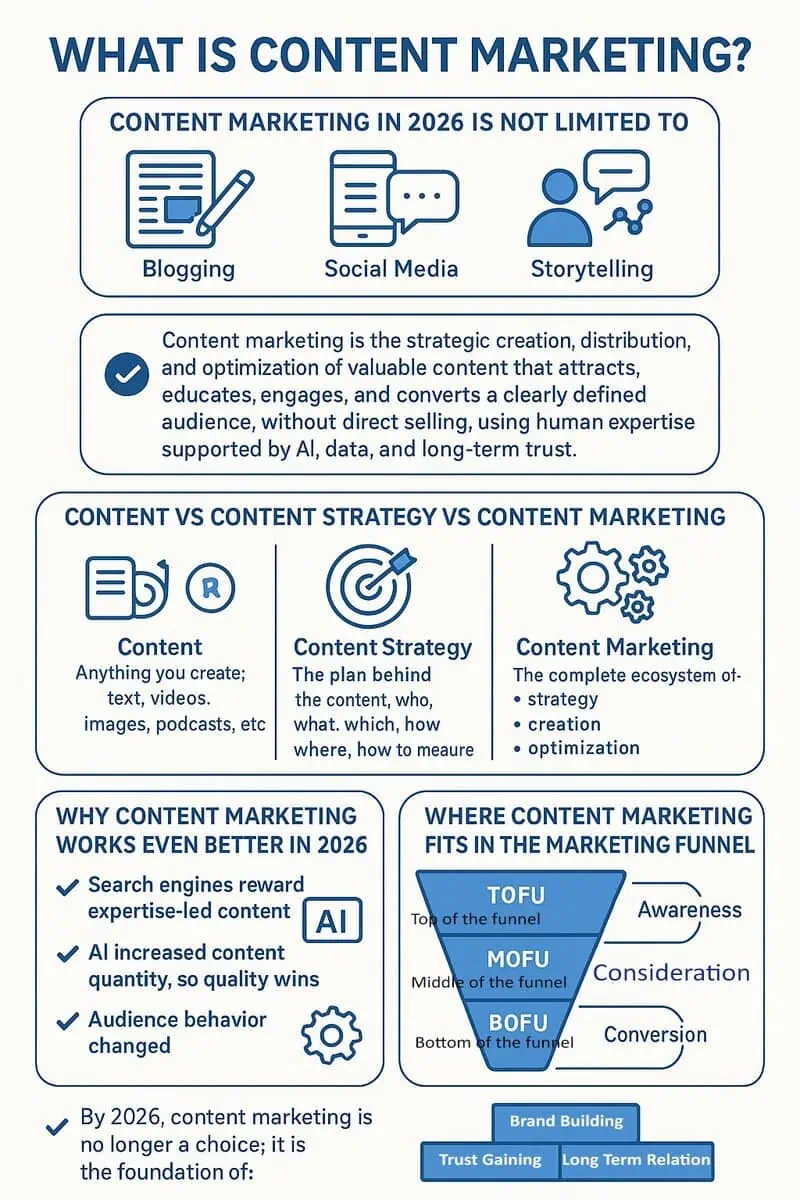
Content marketing in 2026 is not limited to blogging, social media, or storytelling.
✔ 2026 Definition (Short Version)
Content marketing is the strategic creation, distribution, and optimization of valuable content that attracts, educates, engages, and converts a clearly defined audience — without direct selling — using human expertise supported by AI, data, and long-term trust.
✔ 2026 Definition (Long Version)
Content marketing is a full-funnel, multi-format, trust-building system where brands create and deliver meaningful content driven by:
- Real experience (E)
- Verified expertise (E)
- Demonstrated authority (A)
- Strong ethical trustworthiness (T)
- Modern SEO and distribution strategy
- Human creativity supported by AI
The result?
- Higher visibility
- Stronger brand trust
- Better lead quality
- More informed customers
- Lower acquisition cost
- Long-term growth
✔ What Content Marketing Is NOT (2026 Clarification)
Content marketing is NOT:
- Posting random content on social media
- Mass-producing AI articles
- Rewriting popular topics
- Promotional content disguised as information
- Chasing keywords without expertise
- “Publish more” approach without strategy
Content marketing in 2026 is precision + value + expertise.
2.1 Content vs Content Strategy vs Content Marketing
(Important distinction for E-E-A-T & AI Overview clarity)
Content
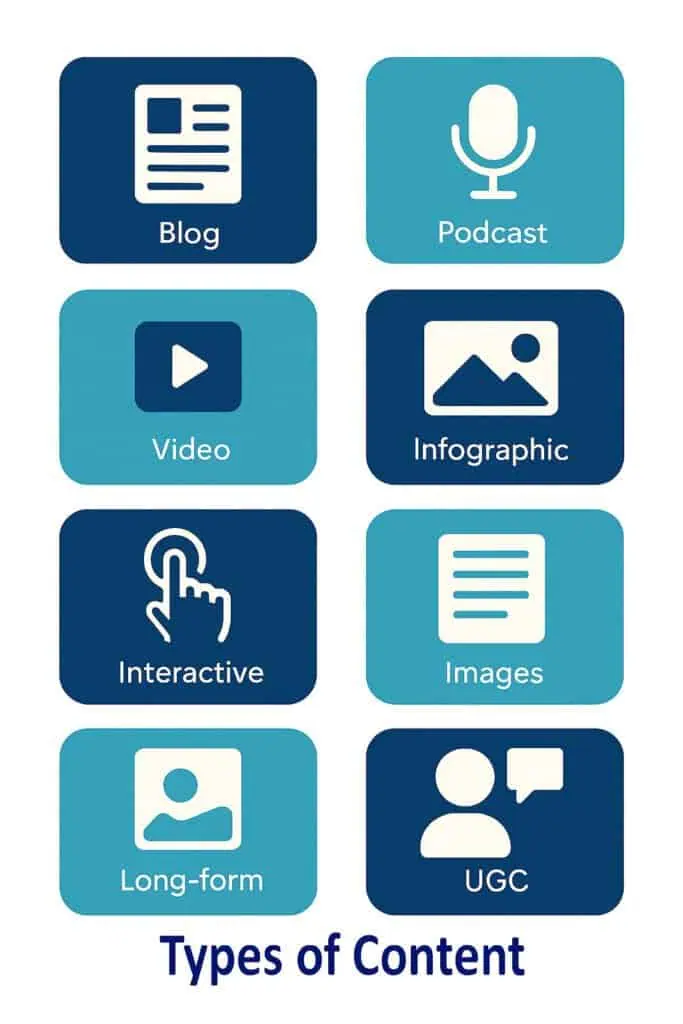
Anything you create: text, videos, reels, images, podcasts, carousels, templates, diagrams, infographics, guides, etc.
Types of content are many. Which format or which types of content can suit you to achieve your goal depends on the strategies, planning, and relevant ecosystem. Before proceeding further, let’s have a brief overview of content strategies and content marketing.
Content Strategy
It’s the plan behind the content :
- Who is the audience?
- What problems are we solving?
- Which formats will we use?
- How often will we publish?
- Where will we distribute?
- How will we measure success?
Content Marketing
It’s the complete ecosystem of:
- Strategy
- Creation
- Optimization
- Distribution
- Measurement
- Improvement
Content creation without a strategy is noise.
Content marketing unites both.
2.2 Inbound Marketing vs Content Marketing (Updated 2026 View)
Is content marketing an inbound marketing strategy? This is where many beginners get confused. Let’s clear it:
🔹 Content Marketing
Focuses on what you create.
🔹
Inbound Marketing
Focuses on how you attract.
Simple relationship:
Inbound marketing is the broader system that uses content to attract, engage, and convert potential customers. Content marketing is a part of inbound marketing.
Inbound marketing also includes:
- Email funnels
- Automation
- Landing pages
- Lead magnets
- Buyer journeys
In 2026, inbound integrates:
- AI-powered audience segmentation
- Behavioural triggers
- Personalised follow-ups
- Zero-click platforms (Google, TikTok, Instagram)
2.3 Why Content Marketing Works Even Better in 2026
✔ Search engines reward expertise-led content
AI Overviews pull content from:
- Sites with strong clusters
- First-hand experience
- Clear author identity
BUT NOT from websites that are publishing more.
✔ AI increased content quantity, so quality wins
Everyone can create content fast. But only a few can create:
- Helpful
- Original
- Experience-driven
- Insightful
- Trust-building
This is your advantage.
✔ Audience behaviour changed
People now prefer:
- Short-form + long-form combinations
- Real stories
- Data
- Templates
- Examples
- Actionable frameworks
If your content delivers these, you will win.
2.4 Where Content Marketing Fits in the Marketing Funnel
Content supports every stage:
TOFU (Top of Funnel) – Awareness
- Educational blogs
- Reels
- YouTube Shorts
- Infographics
- How-to guides
MOFU (Middle of Funnel) – Consideration
- Comparison posts
- Case studies
- Checklists
- Long videos
- E-books
- Email sequences
BOFU (Bottom of Funnel) – Conversion
- Product/service pages
- Testimonials
- Demos
- Pricing pages
- FAQs
- Personalized recommendations
Retention & Loyalty
- Newsletters
- Updates
- Insider content
- Community content
✔ Conclusion of Section 2
By 2026, content marketing is no longer a choice; it is the foundation of:
- Visibility
- Trust
- SEO
- AI Overview presence
- Customer relationships
- Brand building
The next section (Section 3) will explain exactly WHY content marketing remains the strongest growth engine, supported by data, psychology, and modern digital behaviour.
3. Why Content Marketing Still Works (And Works Better Now)
The core principles of content marketing haven’t changed, but the world around it has changed dramatically. Consumer behaviour, search engines, social platforms, AI tools, and even trust psychology have evolved.
Yet in 2026, content marketing is delivering higher ROI and stronger long-term results than almost every other digital marketing strategy.
Here’s why.
3.1 People Don’t Trust Ads, They Trust Content
📉 Decline of ad trust
According to multiple 2024–2026 studies (Statista), Backlinko, and GWI:
- 77% of people immediately skip or ignore ads (source).
- 43% use ad blockers (GWI report).
- People trust ads far less than user reviews, tutorials, and expert blogs (Backlinko trust study).
Why?
Because ads sell. Content guides.
Humans are wired to trust information that:
- Educates
- Explains
- Shows experience
- Solves a real problem
3.2 Customers Research Like Never Before
In 2015, people might have searched once and made a decision.
In 2026:
- People do multiplatform research
- Across 5–12 touchpoints
- Before making any purchase, even a simple ₹499 product
What this means:
👉 Content must exist everywhere your customer goes:
- AI Overviews
- YouTube
- TikTok
- Brand website
Content marketing allows you to be present in their research journey without pushing a sale.
3.3 Search Engines Reward Real Experience ( E-E-A-T )
Since the 2023–2026 updates, Google has made something very clear:
Experience-based content outranks AI-generated content, which is why the idea of ranking fast often fails for new sites in 2026.
Even if two articles are similar:
- The one written with real examples,
- Practical insights,
- Case snapshots,
- And an authentic experience
…wins every time.
3.4 AI Overviews Changed Everything, But Benefited High-Quality Content
Google’s AI Overview (AIO) introduced a new rule:
- It doesn’t link to random sites
- It pulls from trusted, authoritative content clusters
Meaning:
Content with:
- Strong E-E-A-T
- Topical depth
- Clear navigation
- Semantic connections
…wins in AIO.
3.5 AI Has Increased Content Quantity, So Quality Wins
10,000 average-quality AI articles can’t beat:
- 1 detailed guide
- 7 supporting clusters
- Clear real-world expertise
If an article is not only informative but experientially credible, that combination beats AI-generated content every day.
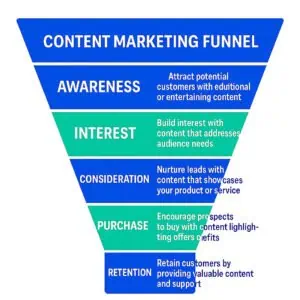
3.6 Content Drives the Full Funnel (Awareness → Purchase → Retention)
Awareness (TOFU)
Blogs, reels, shorts, guides, and infographics bring strangers into your world.
Consideration (MOFU)
Comparison posts, case studies, and checklists help people understand solutions.
Conversion (BOFU)
Service pages, FAQs, reviews, and demos convert interested people into buyers.
Retention
Newsletters, exclusive content, and communities keep customers loyal. No single ad campaign or social strategy can do all four.
3.7 Content Lowers Your Customer Acquisition Cost (CAC)
When your content ranks:
- You get visitors without paying per click
- You build authority passively
- You reduce dependency on expensive ads
This makes content one of the highest-ROI investments for brands. It works even better for SMEs and local businesses , which is exactly what freelancers and digital marketing agencies target.
3.8 Content Lasts Longer Than Any Paid Method
A Google Ad stops the moment you stop paying. A Facebook boost dies in 24 hours. But a good piece of content:
- Ranks for years
- Grows in visibility
- Gains backlinks
- Builds authority
3.10 Content Creates an Everlasting Competitive Advantage
AI can write content. Tools can optimize it. But only humans with experience can:
- Share stories
- Explain failures
- Provide real insights
- Compare tools from practice
- Give practical examples
- Speak with authority
This is something 99% of your competitors will never do if you master content marketing. Your advantage is experience-led content. So never try to produce anything generic. For that purpose, AI is adequate.
3.11 Summary of Why Content Marketing Works in 2026
Content works because:
- ✔ People trust content, not ads
- ✔ Customers research before buying
- ✔ Experience-based content dominates AI-written content
- ✔ Google AI Overview rewards strong content clusters
- ✔ Quality > quantity is the new rule
- ✔ Content is full-funnel
- ✔ CAC drops drastically
- ✔ Content is long-lasting
- ✔ Content builds authority
- ✔ Content is the only sustainable competitive advantage
4. The Four Pillars of Modern Content Marketing (2026 Edition)
(Strategy → Creation → Distribution → Optimization)
The world of content has expanded, tools have evolved, and channels have multiplied, but the fundamentals of content marketing can still be grouped into just four pillars.
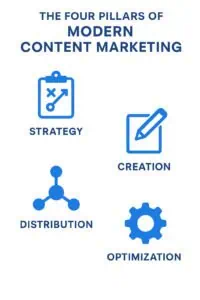
Every successful content program in 2026 stands on these four foundational pillars:
- Content Strategy
- Content Creation (Human + AI Co-Creation)
- Content Distribution
- Content Optimization (SEO, AIO, and Iteration)
Let’s explore each pillar in depth.
4.1 Pillar 1 · Content Strategy (The Brain)
Content strategy is the thinking behind your content. It tells you:
- What to create
- Why you’re creating it
- Who it serves
- What outcome it must achieve
- How it connects to business goals
Without a strategy, content becomes scattered, inconsistent, and ineffective.
4.1.1 What Content Strategy Includes
A full 2026-ready strategy covers:
- Goal setting (SMART + business-aligned)
- Audience definition (ICP + persona + JTBD)
- Search intent analysis
- Content type selection (blogs, reels, videos, guides)
- Topic and keyword research (semantic + entity-based)
- Content calendar planning
- Brand voice definition
- Distribution plan
- Measurement framework
4.1.2 Why Content Strategy Matters
Because it prevents:
- Random content
- Wasted energy
- Inconsistent quality
- Poor targeting
- Low ROI
And it ensures:
- Content that solves real problems
- Content aligned with audience expectations
- Predictable growth
- Measurable results
- Real business impact
4.2 Pillar 2 · Content Creation (The Engine)
Human Expertise + AI Assistance
In 2026, content creation has become a collaboration: humans provide expertise, AI provides efficiency.
The winning formula is: Human Experience + AI Speed + Brand Originality
4.2.1 Content Creation Framework (Modern)
A modern content creation workflow includes:
- Research (AI-assisted + human validation)
- Outlining with search intent alignment
- First draft (created by human, reviewed by AI)
- Human refinement (examples, stories, expertise)
- Fact-checking
- Brand voice editing
- Visual + multimedia integration
- E-E-A-T layer insertion
4.2.2 Human vs AI Roles
Both human and AI have clear roles in the workflow:
| Task | Human | AI |
|---|---|---|
| Real experience | ✔ | ✖ |
| Case studies | ✔ | ✖ |
| Brand voice | ✔ | ✖ |
| Research | ✔ | ✔ |
| Outline | ✔ | ✔ |
| First draft | ✔ | ✖ |
| Rewriting | ✔ | ✔ |
| Polishing | ✔ | ✖ |
| Accuracy | ✔ | ✖ |
You keep control. AI accelerates the process.
4.2.3 Multimedia Content Is Mandatory
In 2026, content requires multiple formats:
- Short videos
- Infographics
- Carousels
- Reels
- Screenshots
- Templates
- Emails
- PDF guides
- Checklists
Single-format content no longer performs well.
4.3 Pillar 3 · Content Distribution (The Reach System)
Great content is wasted if nobody sees it.
Distribution ensures that your content reaches the right audience at the right time.
This pillar includes:
- SEO distribution (ranking in Google)
- Social media distribution
- Community distribution
- Email distribution
- Partnerships and collaborations
- Paid amplification
- Zero-click distribution
4.3.1 Distribution Channels in 2026
A strong plan uses a combination of:
Owned Channels
Earned Channels
- User-generated content (UGC)
- Reviews
- Social shares
- Mentions, PR
- Influencer shoutouts
Paid Channels
- Boosted posts
- Google Ads for content
- Native ads
- Social ads
4.3.2 Why Distribution Is More Important Than Creation
Because in 2026:
Your reach determines your results.
Even great content dies without distribution.
4.4 Pillar 4 · Content Optimization (The Growth Accelerator)
SEO + AIO + Iteration
Optimization ensures your content:
- Ranks
- Stays updated
- Gains visibility
- Captures AI Overviews
- Stays relevant
- Stops decaying
This pillar includes:
- Search engine optimization (semantic + technical)
- AI Overview optimization (entity-rich content)
- On-page enhancements
- Internal linking (pillar → cluster)
- Analytics tracking
- Content refresh cycles
4.4.1 SEO Today Is Entity-Based
Instead of ranking keywords, Google now ranks:
- Topics
- Entities
- Experience
- Authority
- Relationships
This is why a Pillar + Cluster Model is your best E-E-A-T strategy.
4.4.2 Optimization Steps for Every Content Piece
Before and after publishing, apply this checklist:
- Check search intent
- Add entity-rich language
- Improve clarity
- Strengthen structure
- Add original insights
- Insert visuals
- Add internal/external links
- Update outdated parts
- Review performance metrics
- Include author credentials
4.4.3 Why Optimization Matters
Content performance drops naturally over time. Regular optimization ensures:
- Higher rankings
- Better user engagement
- Stronger authority
- More organic traffic
- Long-term results
5. Step-by-Step Content Marketing Framework (2026 Edition)
A practical, actionable, beginner-to-advanced execution guide
This is the exact workflow used by agencies, content teams, and solo creators in 2026. It combines strategy, AI support, human expertise in SEO, distribution, and optimization.
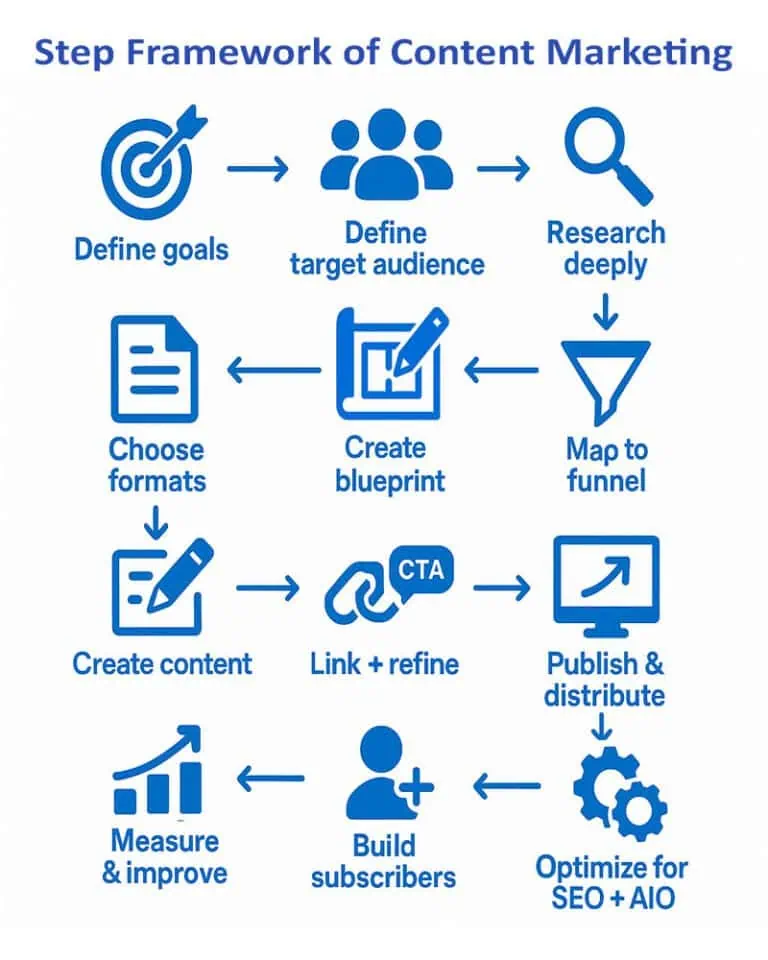
Here are 13 steps that will take you from idea → content → visibility → results.
Step 1: Define Objectives and Business Goals
Content without a goal is noise. Content with a clear objective becomes a strategy.
What you must decide first:
- What do you want to achieve?
- Why are you creating this content?
- How will success be measured?
2026-Friendly Goal-Setting Frameworks
Use SMART goals :
- Specific
- Measurable
- Achievable
- Relevant
- Time-bound
Enhance with:
- ICP (Ideal Customer Profile) relevance
- JTBD (Jobs To Be Done) thinking
- Business alignment (traffic, leads, sales, authority, retention)
Goal Examples
- “Generate 500 monthly organic visitors in 90 days.”
- “Rank top 3 for ‘ local SEO for small businesses ’ in 120 days.”
- “Build an email list of 1,000 subscribers through content downloads.”
Step 2: Define Your Target Audience
Knowing your audience shapes everything else.
Modern Audience Definition Includes:
- Demographics – age, city, income, job
- Psychographics – interests, goals, motivations
- Search intent – what they want to know now
- Pain points – obstacles they face
- JTBD – what they are “trying to get done”
- Buying behavior – decision-making patterns
2026 Audience Tools
- Google Search Console
- Reddit / Quora analysis
- YouTube search trends
- TikTok trend insights
- Google Trends
- Keyword tools (SEMrush / Ahrefs / GA4 search query data)
Ask these questions:
- Who exactly will benefit from this content?
- What problem are they facing?
- What is the search intent behind their queries?
When you know the audience right, content automatically becomes powerful.
Step 3: Conduct Research and Market / Competitor Analysis
This step prevents guesswork and ensures content relevance.
5.3.1 Keyword & Topic Research
Use:
- Google Autosuggest
- People Also Ask
- AI Overviews (identify patterns)
- Ahrefs / SEMrush
- AnswerThePublic
- Reddit, Quora, X posts
- YouTube suggestions
5.3.2 Competitor Analysis
Look at:
- What competitors rank for
- Their content type and angle
- Gaps in their content
- Outdated areas
- Missed opportunities
5.3.3 Audience Behavior Signals
Check:
- What questions your audience asks
- Which formats they prefer (reels, blogs, videos)
- Content that gets high engagement on social platforms
5.3.4 Gap Analysis
Identify:
- What is missing in the content landscape
- What you can explain better
- Where you can bring experience-driven value
This is how you produce original, differentiated content, not “me-too content”.
Step 4: Map Content to the Marketing Funnel (TOFU → MOFU → BOFU)
Each stage requires different content.
TOFU – Awareness
Goal: attract people
Content:
- How-to guides
- Educational blogs
- Short videos
- FAQs
- Listicles
- Introductory explainers
MOFU – Consideration
Goal: nurture interest
Content:
- Comparison guides
- Buyer’s guides
- Checklists
- Case studies
- In-depth tutorials
- Webinars
BOFU – Conversion
Goal: drive action
Content:
- Product / service pages
- Testimonials
- Pricing pages
- Demos
- FAQ lists
- Features vs benefits comparisons
Retention & Relationship
Goal: keep customers engaged
Content:
- Newsletters
- Community updates
- WhatsApp insights
- Customer-only content
Mapping content to the funnel ensures business impact, not just traffic.
Step 5: Decide the Content Type & Format
2026 content is highly multi-format.
Text
- Blogs
- Pillar pages
- Listicles
- Guides
- Case studies
Visual
- Infographics
- Carousels
- Image explainers
- Comparison charts
Video
- Short-form (Reels, Shorts, TikTok)
- Long-form (YouTube tutorials)
- Screen recordings
- Animation videos
Interactive
- Quizzes
- Tools
- Calculators
- Templates
- Checklists
Audio
- Podcasts
- Audio summaries
Zero-Click Content (crucial for 2026)
- LinkedIn text posts
- Tweets / X threads
- Instagram educational carousels
- YouTube Community posts
Choose formats that your audience consumes the most.
Step 6: Create a Blueprint (Content Outline)
Before writing, plan the structure.
Your outline must include:
- Title
- Introduction
- Key sections
- Sub-sections
- Bullet points
- Visual ideas
- Questions to answer
- Competitor gaps to fill
- E-E-A-T elements to include
This step ensures:
- Clarity
- Flow
- Logical structure
- SEO alignment
- No repetition
- No missing insights
Without a blueprint, content becomes messy.
Step 7: Create Content (Human + AI Workflow)
The most important step.
5.7.1 Use AI for:
- Keyword list generation
- Related topics
- Content outlines
- Draft structuring
- Example generation
- Reformulation
- Grammar polishing
5.7.2 Use Human Expertise for:
- Insights from real experience
- Storytelling
- Case studies
- Industry-specific examples
- Opinions & comparisons
- Ethical judgment
- Accuracy verification
5.7.3 Insert E-E-A-T Layer
Add:
- Your experience (“When we implemented this for a client…”)
- Real examples
- Results
- Personal stories
- Screenshots
- Author credentials
This is what beats AI-written content.
Step 8: Edit, Fact-Check, and Proofread
Great content becomes excellent through editing.
Editing Layers:
- Clarity
- Structure
- Readability
- Brand voice
- Accuracy
- Tone
- SEO placement
- Grammar
Avoid:
- Fluff
- Repetition
- Over-explaining
- Jargon
- Incorrect facts
- Unverified data
It must be a human-written, expert-driven, polished piece.
Step 9: Add Internal Links, External Links & Useful CTAs
Linking ensures:
- SEO strength
- Better engagement
- Lower bounce rate
Internal Links (critical for pillar + cluster model):
- From clusters → pillar
- From pillar → clusters
- Cross-links among clusters
External Links:
- Credible sources
- Research studies
- Official data
- Industry publications
CTAs:
- Subscribe
- Download checklist
- Book a call
- Explore services
Subtle CTAs convert better than salesy ones.
Step 10: Publish & Distribute Content
Do not publish silently.
Distribute across:
- Website
- Social platforms
- Facebook groups
- Email lists
- YouTube Community
- Reddit & Quora (if relevant)
- Medium reposting
80/20 rule:
- 20% time creating
- 80% time distributing
That’s how content grows.
Step 11: Optimize for Search Engines & AI Overviews (2026 Rules)
This is where long-term traffic comes from.
5.11.1 SEO Optimization
- Semantic keywords
- Entities
- Clear structure
- Short paragraphs
- H2 / H3 hierarchy
- Schema markup
- Relevant internal links
- Quality visuals
- Fast loading
- Mobile-first
5.11.2 AI Overview Optimization
- Use entity-rich language
- Use concise definitions
- Answer questions directly
- Use lists, tables, frameworks
- Use step-by-step sections
- Add author bio and credentials
- Use pillar + cluster linking
5.11.3 Content Refresh Cycles
Refresh:
- Every 3 months for high-value posts
- Every 6 months for medium-value posts
- Yearly for evergreen content
Optimization = growth.
Step 12: Ask Users to Subscribe (Optional but High ROI)
Build your content-based email list using:
- Newsletter
- Insights
- Templates
- Guides
- Case studies
Subscribers drive:
- Repeat traffic
- Higher conversions
- Brand authority
Step 13: Measure Performance & Improve Continuously
Use:
- Google Analytics (GA4)
- Google Search Console
- Heatmaps
- Social insights
- Email open rates
- Content engagement metrics
Ask:
- What is working?
- What needs improvement?
- What topics need expansion?
- What content has decayed?
Growth comes from continuous refinement.
Summary of the 2026 Framework
This 13-step framework creates a predictable, repeatable content system:
- Define goals
- Define target audience
- Research deeply
- Map to funnel
- Choose formats
- Create blueprint
- Create content
- Edit & refine
- Link + CTA
- Publish & distribute
- Optimize for SEO + AIO
- Build subscribers
- Measure & improve
This is the entire engine of modern content marketing.

Author Bio — P. R. Sahoo
P. R. Sahoo is an academic thinker, researcher, and digital strategist working at the intersection of language, technology, structured learning, and digital innovation. With 18+ years of experience in higher education and curriculum development, he focuses on Linguistics, Research Methodology, scholarly editing, and the evolving role of AI in productivity enhancement and digital creativity.
His academic work includes the Development of the Nirgun School in Odia Literature, Characteristics of Odia Language, Subaltern Studies, developing bilingual syllabi, research writing frameworks, modern pedagogical models, and accessible learning materials for diverse student groups.
Beyond academia, he leads and manages large-scale digital and creative initiatives through multiple websites, where he builds and refines high-performance web architectures, long-form content systems, SEO ecosystems, and data-driven digital strategies. His technical expertise spans Core Web Vitals optimization, schema engineering, funnel-based content ecosystems, and structured content planning, helping new learners understand the underlying mechanics of digital growth.
His work blends academic clarity, technical depth, and creative storytelling, making complex ideas approachable for students, beginners in digital marketing, and early-stage start-up founders. The purpose of this pillar article, with 10,386 words with two dozen learning infographics, is not client-centered marketing, but learner-oriented knowledge building—a structured foundation for individuals exploring digital marketing, content strategy, and early entrepreneurial thought.
This long-form writing is part of his broader pilot initiative to connect academic perspectives with practical digital frameworks—empowering learners to evolve from conceptual understanding to structured, confident, and creatively grounded digital execution.
Connect with the author:
🔗 Facebook: https://www.facebook.com/prsahoo.official